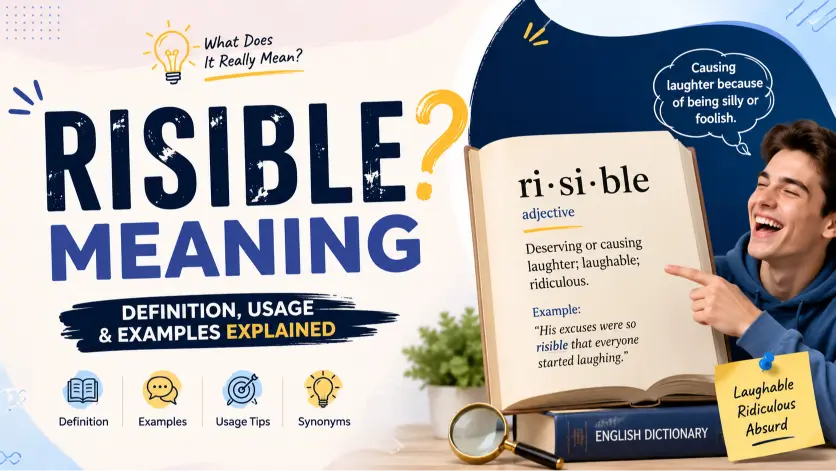
Have you ever read a news headline, heard an unbelievable excuse, or seen a social media comment that made you think, That’s completely ridiculous! If so, you’ve already experienced the idea behind risible meaning even if you didn’t know the word.
Risible is one of those impressive English words that appears in newspapers, books, academic writing, and everyday conversations. While it isn’t as common as words like funny or ridiculous, it expresses a very specific idea: something so absurd that it deserves laughter.
Many English learners also confuse risible with words like hilarious or amusing. They’re related, but they aren’t exactly the same. Understanding the difference can improve both your vocabulary and your writing.
In this guide, you’ll learn the complete risible meaning, where the word comes from, how native speakers use it today, how to pronounce it correctly, and when it’s appropriate to use. You’ll also discover practical examples, common mistakes to avoid, and related words that help you sound more natural in English.
What Does Risible Meaning Mean?
Quick Answer
Risible means so ridiculous, foolish, or absurd that it causes laughter or deserves to be laughed at. Today, it is usually used as a criticism rather than a compliment.
Simple Definition
The risible meaning is straightforward:
A person, statement, excuse, or situation is risible when it is laughably silly or absurd.
Unlike words such as funny or entertaining, risible often carries a sense of criticism. It suggests that something isn’t merely amusing—it is so unreasonable or foolish that people can’t help but laugh.
For example:
- His explanation for arriving three hours late was absolutely risible.
- The advertisement made several risible claims that nobody believed.
- Many voters considered the promise risible because it was impossible to achieve.
Notice how each sentence expresses disbelief or criticism rather than simple humor.
The Origin of “Risible”
The word risible has a long history that stretches back to classical Latin.
It comes from the Latin word risibilis, meaning able to laugh or capable of laughter. This Latin term developed from the verb ridere, which means to laugh.
English adopted risible during the 16th century, when scholars borrowed many Latin words into formal writing.
Originally, the word described people or living beings that were capable of laughing.
Example of the older meaning:
Humans are risible creatures because they can laugh.
Over time, however, English speakers gradually shifted the meaning.
Instead of describing someone who laughs, risible came to describe something that causes laughter because it is ridiculous.
This newer meaning is now by far the most common in modern English.
Is “Risible” Positive or Negative?
In modern English, risible is almost always negative.
It is commonly used when criticizing:
- unrealistic promises
- weak arguments
- poor excuses
- exaggerated claims
- foolish decisions
- absurd behavior
For example:
- The company’s explanation was risible.
- His excuse sounded risible.
- Many experts dismissed the theory as risible.
When Do People Use “Risible”?
Native English speakers often use risible in formal or semi-formal contexts, including:
- Newspaper articles
- Political commentary
- Opinion pieces
- Academic discussions
- Business writing
- Book reviews
- Editorials
For example:
- A journalist may describe a false claim as risible.
- A reviewer may call a movie plot risible.
- A professor may refer to an unsupported argument as risible.
How to Use Risible Correctly in Texts & Chat
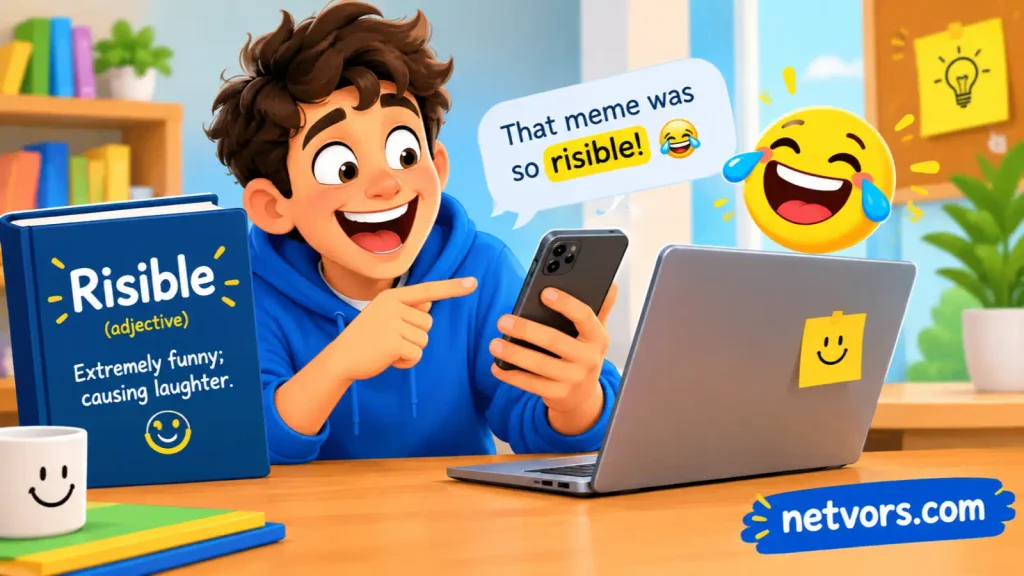
Knowing the risible meaning is only half the battle. The next step is learning how native English speakers actually use the word in conversations, online discussions, and writing.
The easiest rule to remember is this:
Use “risible” to criticize something that is so ridiculous it deserves laughter—not something that is simply funny.
For example:
✅ His excuse for missing the meeting was risible.
✅ The rumor sounded so risible that nobody believed it.
❌ The comedian was risible.
(This sounds unnatural because comedians are usually described as funny or hilarious, not risible.)
Casual vs-Formal Usage

Although risible appears in everyday English, it has a slightly formal tone. You’ll see it more often in newspapers, editorials, reviews, and professional writing than in casual text messages.
| Situation | Is “Risible” Appropriate? | Example |
|---|---|---|
| Text messages | ✅ Sometimes | “That excuse is risible 😂.” |
| WhatsApp chats | ✅ Yes | “His story is absolutely risible.” |
| Instagram comments | ✅ Yes | “Those claims are risible.” |
| Reddit discussions | ✅ Common | “That argument is risible.” |
| Discord chats | ✅ Occasionally | “The strategy was risible lol.” |
| Academic writing | ✅ Yes | “The hypothesis appears risible.” |
| Business emails | ⚠️ Use carefully | Can sound harsh. |
| Job applications | ❌ No | Too critical. |
| Official reports | ⚠️ Only if appropriate | Better choose neutral wording. |
Platform-Specific Usage
SMS & Text Messages
Friends sometimes use risible to mock a silly excuse or unbelievable story.
Example
Alex: I told my teacher my dog ate my laptop.
Sam: That’s a risible excuse. 😂
Here, risible means “laughably unbelievable.”
People often use the word while discussing news, sports, or everyday situations.
Example
That prediction turned out to be completely risible.
Instagram users may describe exaggerated influencer claims as risible.
Example:
Those “lose 20 pounds overnight” ads are risible.
Twitter/X
Because Twitter rewards short, impactful language, risible is popular among journalists, writers, and political commentators.
Example:
The statement is simply risible.
Reddit discussions frequently use risible during debates.
Example:
That theory is risible because there’s no evidence to support it.
Discord
Gamers occasionally use the word jokingly.
Example:
That boss strategy was risible—we lost in thirty seconds.
When NOT to Use “Risible”
Many learners misuse the word because they think it simply means funny.
Avoid using risible when talking about:
Genuine Humor
❌ That comedian is risible.
Better:
✅ That comedian is hilarious.
Happy Moments
❌ We had a risible evening together.
Better:
✅ We had a fun evening.
Compliments
❌ Your joke was risible.
Native speakers may misunderstand this as criticism.
Instead say:
- hilarious
- funny
- entertaining
- amusing
Tone and Emotion
The word usually communicates one or more of these emotions:
- disbelief
- sarcasm
- criticism
- mockery
- disappointment
- irony
It rarely expresses joy.
For example:
His explanation was risible.
The speaker isn’t praising the explanation—they’re saying it’s absurd.
Emoji Pairings
When used online, risible often appears alongside emojis such as:
😂 Laughing Face
🤣 Rolling on the Floor Laughing
🙄 Eye Roll
🤦 Face Palm
😅 Nervous Laugh
Example:
That excuse is risible. 🤦😂
Capitalization Tips
Normally write it in lowercase:
The argument sounds risible.
Use uppercase only for emphasis.
That excuse is RISIBLE.
Real Conversation Examples Using Risible
Below are realistic examples showing how the word naturally appears in different situations.
Example 1 — Between Friends
Emma:
I told Mom traffic made me late.
Jake:
But school is five minutes away.
Emma:
I know…
Jake:
That’s a pretty risible excuse.
Meaning
Jake thinks the excuse is obviously unbelievable.
Example 2 — Dating
Sarah:
He said his phone died for three days.
Amy:
That’s risible.
Sarah:
Exactly.
Meaning
Amy believes the excuse is absurd rather than believable.
Example 3 — Family Conversation
Dad:
You didn’t clean your room because your goldfish distracted you?
Son:
Maybe…
Dad:
That’s absolutely risible.
Meaning
Dad is pointing out how ridiculous the excuse sounds.
Example 4 — Work Chat
Manager:
The report disappeared because the computer was “having feelings”?
Employee:
…
Manager:
That explanation is risible.
Meaning
The manager rejects the excuse as laughably unrealistic.
Example 5 — Gaming
Player 1:
We lost because my keyboard blinked once.
Player 2:
Risible excuse.
Meaning
The excuse is clearly not taken seriously.
Common Mistakes & Misunderstandings
Even advanced English learners sometimes misuse risible. Here are the most common mistakes.
Mistake 1: Confusing “Risible” with “Funny”
Many people assume both words have the same meaning.
Incorrect:
The comedy show was risible.
Better:
The comedy show was hilarious.
Remember:
Funny = intended humor
Risible = ridiculous enough to be laughed at
Mistake 2: Using It as a Compliment
Because laughter is involved, some learners think risible is positive.
Incorrect:
Your speech was risible.
Native speakers may interpret this as an insult.
Better:
Your speech was inspiring.
Mistake 3: Using It Too Often
Since risible is a fairly formal word, repeating it throughout a conversation can sound unnatural.
Instead, mix it with words like:
- ridiculous
- absurd
- laughable
- preposterous
- unbelievable
This variety makes your writing smoother and more natural.
Generational Differences
Gen Z
Usually prefers:
- ridiculous
- wild
- delulu
- clown behavior
- goofy
They understand risible, but don’t use it often.
Millennials
More likely to encounter risible in journalism, books, or online debates than in everyday speech.
Older Generations
Older speakers, academics, lawyers, journalists, and editors use risible more frequently, especially in formal discussions.
Cultural Differences
In countries such as the United Kingdom, you’ll see risible more often in newspapers and political commentary than in everyday conversation.
In the United States, people usually choose simpler alternatives like:
- ridiculous
- absurd
- laughable
Even so, educated readers will recognize risible immediately.
Risible Across Different Platforms & Demographics
Although risible is a standard English word rather than internet slang, its usage varies depending on the platform, audience, and context. Knowing where you’re most likely to encounter it helps you use it naturally.
How Different Generations Use “Risible”
Gen Z
Gen Z understands risible, but it’s not a word they use every day. Instead, they often prefer modern slang such as:
- Delulu
- Clown behavior
- Wild
- Unhinged
- Ridiculous
You might occasionally see risible in educational content, book discussions, or debates on Reddit, but it’s uncommon in casual TikTok comments.
Millennials
Millennials are more likely to recognize and use risible, especially if they read news articles, opinion pieces, or long-form online content.
Example:
“That company’s excuse is risible.”
Gen X and Baby Boomers
Older generations, especially professionals, journalists, lawyers, and academics, use risible more comfortably in formal writing and discussions.
You’ll often find sentences like:
“The proposal was dismissed as risible.”
Where You’ll See “Risible” Online
| Platform | How Common? | Typical Usage |
|---|---|---|
| TikTok | ⭐ Low | Educational videos, vocabulary creators |
| ⭐⭐ Low–Medium | News pages, book accounts, grammar creators | |
| X (Twitter) | ⭐⭐⭐⭐ High | Politics, journalism, opinion posts |
| ⭐⭐⭐⭐ High | Debates, discussions, intellectual communities | |
| Discord | ⭐⭐ Medium | Occasionally in gaming or debate servers |
| ⭐⭐⭐ Medium | News discussions and community groups | |
| ⭐⭐ Medium | Rare, but may appear in professional articles |
Has “Risible” Ever Gone Viral?
Unlike internet slang terms such as rizz, delulu, or NPC, risible hasn’t become a viral social media trend.
Instead, it regularly appears in:
- Political commentary
- Editorials
- Opinion columns
- Court reporting
- Book reviews
- Academic discussions
Because of this, the word has maintained a reputation as a polished, educated vocabulary choice rather than a trendy buzzword.
Related Words, Synonyms & Alternatives
Expanding your vocabulary helps you express yourself more naturally. Here are several words related to risible meaning and how they differ.
| Word | Meaning | Best Used When |
|---|---|---|
| Ridiculous | Extremely unreasonable | Everyday conversations |
| Laughable | Deserving ridicule | Similar to risible |
| Absurd | Completely illogical | Formal and informal writing |
| Ludicrous | Ridiculously unreasonable | Strong criticism |
| Preposterous | Contrary to common sense | Formal arguments |
| Silly | Lacking seriousness | Casual conversations |
| Comical | Funny in an amusing way | Entertainment |
| Hilarious | Extremely funny | Positive humor |
| Farcical | Ridiculously unrealistic | Politics, theater, satire |
| Outrageous | Shockingly unreasonable | Emotional reactions |
Suggested Internal Linking Opportunities
If your website covers English vocabulary or internet language, consider linking to related articles using anchor text like:
- laughable meaning
- absurd meaning
- ridiculous meaning
- sarcasm meaning
- irony meaning
These related topics help readers deepen their understanding while improving your site’s internal SEO structure.
FAQs:
What does risible mean in simple words?
Risible means something is so foolish, ridiculous, or absurd that people laugh at it. Today, the word is usually used to criticize an idea, excuse, or action rather than to describe something genuinely funny.
Is risible a negative word?
Yes. In modern English, risible almost always has a negative meaning. It suggests that something deserves ridicule because it is unreasonable or unbelievable.
What’s the difference between risible and hilarious?
Hilarious describes something intentionally funny and entertaining.
Risible describes something unintentionally funny because it’s ridiculous or absurd.
Is risible a formal word?
Yes. Risible is more formal than words like funny or ridiculous. It’s commonly used in journalism, literature, legal writing, and academic discussions.
Can I use risible in everyday conversation?
You can, but many native speakers prefer simpler words such as ridiculous or absurd in casual speech. Risible works best when you want a more sophisticated or precise vocabulary.
Conclusion:
Understanding risible meaning helps you recognize a useful English word that often appears in newspapers, books, professional writing, and thoughtful conversations. Rather than describing something that’s simply funny, risible refers to ideas, excuses, or situations that are so absurd they deserve laughter or ridicule.
Remember the key difference: a comedian can be hilarious, but an unbelievable excuse is risible. Using the word correctly will make your writing more precise and expand your vocabulary beyond everyday terms like ridiculous or silly.
The next time you hear an impossible promise, a weak excuse, or an outrageous claim, you’ll know exactly when risible is the perfect word to use.
What’s your favorite advanced English word? Share it in the comments and explore more vocabulary guides to keep building your English skills!

Hi, I’m John Cate, the voice behind Netvors.com, where I turn confusing words into clear meaning.
I’ve always been fascinated by how language evolves. One day a word means one thing, the next day it means something completely different, especially online. That shift is exactly what inspired me to build Netvors: a space where meanings are simple, accurate, and actually useful.