Have you ever heard someone say, “Can you provide a reference?” or seen a “References” section at the end of an article and wondered what it actually means?
The phrase reference meaning can seem simple at first, but the word “reference” appears in many different situations. You might encounter it when applying for a job, writing a school paper, reading a book, sending an email, or even chatting with friends online.
In its broadest sense, a reference connects one piece of information to another. It helps people verify facts, understand context, or learn more about a topic.
Understanding reference meaning is increasingly important because we live in a world filled with information. Knowing how references work helps you communicate clearly, evaluate sources, and build credibility in both academic and professional settings.
This updated guide explains what reference means, where the term comes from, how it’s used in different contexts, common mistakes people make, and practical examples you can apply immediately.
Updated for 2026.
What Does “Reference” Mean? (Definition + Origin)
Definition
A reference is a mention, source, recommendation, citation, or connection that points to something else for information, proof, explanation, or verification.
Depending on the context, a reference can mean:
- A source cited in writing
- A person who recommends someone for a job
- A mention of another topic or event
- Information used to support a statement
- A direction to consult another source
Quick Answer
Reference meaning: A reference is something that points to, identifies, supports, or provides information about another person, idea, document, or source.
Origin of the Word
The word “reference” comes from the Latin root referre, meaning “to bring back” or “to relate.”
Over time, the term entered Old French and then English, where it evolved to mean:
- Referring to information
- Consulting a source
- Making connections between ideas
- Providing recommendations
Today, the word is used across education, business, publishing, technology, law, and everyday communication.
Pronunciation
Reference
Pronunciation: REF-er-uhns
IPA: /ˈrɛfərəns/
How to Use “Reference” Correctly in Texts & Communication
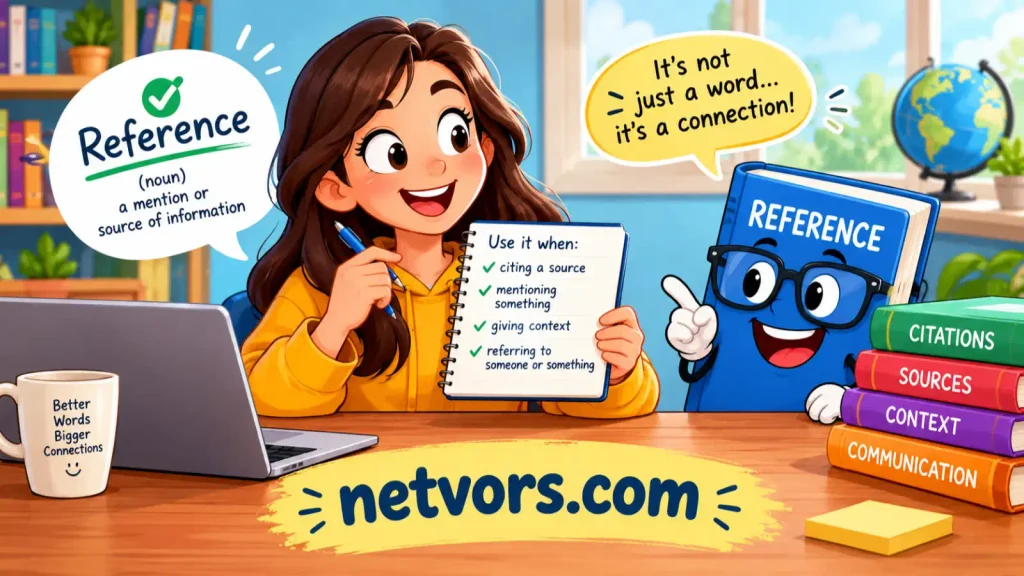
The meaning of reference changes slightly depending on how it’s used.
As a Noun
Examples:
- “Please include your references at the end of the report.”
- “She provided three professional references.”
- “The article contains several references to climate change.”
In these examples, reference refers to a source, recommendation, or mention.
As a Verb
Examples:
- “Please reference the company handbook.”
- “The author referenced several studies.”
- “He referenced last week’s meeting.”
Here, reference means to mention, cite, or consult something.
Different Communication Contexts
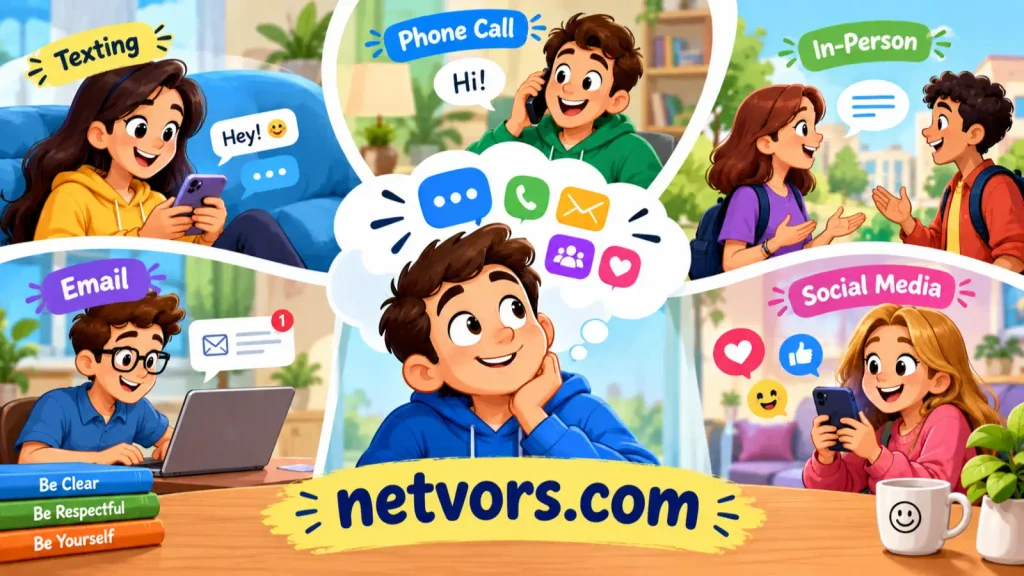
Emails
Professional:
“For reference, I’ve attached last month’s report.”
This means the report is included for information purposes.
Workplace Chats
“Use the previous project as a reference.”
The earlier project serves as a guide or example.
Academic Writing
“Every statistic should include a reference.”
The source must be cited.
Everyday Conversation
“That movie made a reference to the 1990s.”
The movie mentioned or alluded to something from that period.
When NOT to Use It
Avoid using “reference” when you simply mean:
- Guess
- Opinion
- Personal belief
A reference should connect to actual information, evidence, or context.
Formatting Tips
When writing references:
- Use consistent citation styles (APA, MLA, Chicago, etc.)
- Include complete source information
- Verify accuracy before publishing
- Keep formatting uniform throughout a document
Real Conversation Examples Using “Reference”
Example 1: Between Friends
Alex: Did you catch the joke in that movie?
Sam: Yeah, it was a reference to an old TV show.
Meaning: The movie mentioned or alluded to another piece of media.
Example 2: Job Application
Recruiter: Can you provide two professional references?
Jordan: Sure. I’ll send my previous manager and team lead.
Meaning: References are people who can verify work experience and skills.
Example 3: College Assignment
Student: Why did I lose marks?
Professor: You didn’t include references for your sources.
Meaning: Academic references support information and prevent plagiarism.
Example 4: Workplace Chat
Manager: Use last quarter’s presentation as a reference.
Employee: Got it. I’ll follow the same format.
Meaning: A reference acts as a model or guide.
Example 5: Gaming Community
Player 1: That character name sounds familiar.
Player 2: It’s a reference to a famous fantasy novel.
Meaning: The game intentionally points to another work.
Common Mistakes & Misunderstandings
Even native English speakers sometimes misunderstand the word.
Mistake #1: Confusing a Reference With a Recommendation
Many people assume every reference is a recommendation.
Not necessarily.
A reference may simply point to information.
Example:
- Academic reference = source citation
- Job reference = recommendation or verification
Different context, different meaning.
Mistake #2: Thinking References Are Optional
Students often assume references only matter for direct quotations.
In reality, references are needed for:
- Statistics
- Research findings
- Ideas borrowed from others
- Images and charts
- Data sources
Proper referencing builds credibility.
Mistake #3: Using “Reference” and “Refer” Interchangeably
Incorrect:
“I need a refer.”
Correct:
“I need a reference.”
“Refer” is a verb, while “reference” is usually a noun (though it can also be used as a verb).
Generational Differences
Older generations often associate reference with:
- Libraries
- Encyclopedias
- Job applications
Younger generations may encounter references through:
- Online articles
- Hyperlinks
- Social media culture
- Pop-culture references
The core meaning remains the same: pointing to something else.
Cultural Differences
In education systems worldwide, reference requirements differ.
Some countries emphasize:
- APA style
- MLA style
- Harvard referencing
- Chicago style
The formatting changes, but the purpose remains identical: credit sources and help readers verify information.
Reference Across Different Contexts & Demographics
One reason people search for reference meaning is that the word appears in many industries.
Let’s break them down.
Academic References
Used in:
- Essays
- Research papers
- Theses
- Journals
Purpose:
- Support claims
- Avoid plagiarism
- Provide evidence
Example:
Smith, J. (2025). Digital Communication Trends.
Job References
Employers often ask for references before hiring.
Common types include:
- Former managers
- Supervisors
- Professors
- Colleagues
- Clients
These individuals help verify:
- Skills
- Experience
- Reliability
- Professional behavior
References in Books
Authors include references to:
- Historical events
- Other books
- Cultural movements
- Scientific findings
Readers can explore these sources for deeper understanding.
References in Technology
Programmers frequently use:
- API references
- Documentation references
- Code references
Example:
“Check the API reference before implementing the feature.”
References in Pop Culture
Movies, memes, TV shows, and social media often contain references.
Examples include:
- Easter eggs in films
- Meme callbacks
- Song lyrics mentioning older works
- Historical references in games
These create shared cultural understanding.
Formal or Informal?
Reference is generally considered:
| Context | Formality |
|---|---|
| Academic writing | Formal |
| Business communication | Formal |
| Job applications | Formal |
| Social conversation | Neutral |
| Online memes | Informal |
The word itself is safe for work and widely accepted in professional settings.
Related Terms, Abbreviations & Alternatives
Here are related words that often appear alongside reference.
| Term | Meaning |
|---|---|
| Citation | Formal acknowledgment of a source |
| Source | Original provider of information |
| Mention | Brief reference to something |
| Allusion | Indirect reference |
| Recommendation | Positive endorsement |
| Referral | Suggestion to consult a person or service |
| Documentation | Written supporting material |
| Evidence | Information supporting a claim |
| Bibliography | List of sources used |
| Attribution | Giving credit to the original creator |
Synonyms
- Citation
- Mention
- Source
- Acknowledgment
- Referral
- Recommendation
- Attribution
Informal Alternatives
Depending on context:
- Example
- Guide
- Resource
- Point of reference
- Backup source
Opposite Ideas
While reference has no perfect antonym, related opposites include:
- Unsupported claim
- Unverified information
- Anonymous source
- Uncredited material
FAQs:
What is the simplest definition of reference?
A reference is something that points to another source, person, document, or piece of information. It helps provide context, proof, explanation, or verification and is commonly used in education, business, and everyday communication.
What is a reference in academic writing?
In academic writing, a reference identifies where information came from. References allow readers to verify facts, locate original sources, and distinguish the author’s ideas from borrowed material.
What does reference mean in a job application?
A job reference is a person who can speak about your qualifications, work history, skills, and professional character. Employers often contact references before making hiring decisions.
Can reference be used as a verb?
Yes. To reference something means to mention, cite, or refer to it. For example, an author may reference a study, or an employee may reference a company policy during a meeting.
Why are references important?
References improve credibility and transparency. They allow others to verify information, explore sources, avoid plagiarism, and make informed decisions based on reliable evidence.
What is the difference between a reference and a citation?
A citation is a specific formatted mention of a source, while a reference is a broader term that can include citations, recommendations, mentions, or supporting materials. Every citation is a reference, but not every reference is a citation.
Conclusion:
The reference meaning is broader than many people realize. At its core, a reference points someone toward information, evidence, context, or verification.
Whether you’re writing a research paper, applying for a job, reviewing documentation, or discussing a movie Easter egg, references help people connect ideas and confirm facts.
The next time you encounter the word reference, you’ll know it can mean a source, a recommendation, a citation, or even a cultural callback—depending on the situation.
What’s the most common type of reference you use: academic references, job references, or everyday information sources? Share your thoughts and explore more language and communication guides to expand your vocabulary.

Hi, I’m John Cate, the voice behind Netvors.com, where I turn confusing words into clear meaning.
I’ve always been fascinated by how language evolves. One day a word means one thing, the next day it means something completely different, especially online. That shift is exactly what inspired me to build Netvors: a space where meanings are simple, accurate, and actually useful.