Have you ever received a message starting with “re:” or seen words like rewrite, rethink, or replay and wondered what the re prefix meaning actually is? You’re not alone. This tiny two-letter prefix appears in thousands of English words, emails, text messages, and even social media conversations, making it one of the most useful language elements to understand.
The good news? The meaning is surprisingly simple. Once you know how the re prefix works, you’ll instantly recognize the meaning of countless words without reaching for a dictionary. Whether you’re a student, an English learner, a professional writing emails, or simply curious about language, understanding this common prefix can improve both your vocabulary and communication skills.
In this guide, you’ll discover what the re prefix meaning is, where it came from, how it’s used in everyday English, the difference between its meanings in words and emails, and plenty of real-life examples. By the end, you’ll be able to identify and use re- confidently in almost any situation.
What Does “Re” Prefix Mean?
Quick Answer
The prefix “re-” usually means “again” or “back.” It comes from Latin and is added to the beginning of words to indicate repeating an action, returning to a previous state, or doing something anew.
The **re prefix meaning is one of the easiest English prefixes to remember because it generally has two main meanings:
- Again
- Back
For example:
- Rewrite = write again
- Replay = play again
- Rebuild = build again
- Return = come back
- Restore = bring back to its original condition
In most cases, when you see re- at the beginning of a word, you can assume it means repeating an action or moving back to a previous state.
Where Does the Prefix “Re-” Come From?
The prefix re- comes from Latin, where it originally meant “back” or “again.” Over centuries, it became one of the most common prefixes in English because many English words were borrowed from Latin and French.
Today, you’ll find re- in everyday conversations, academic writing, business communication, legal documents, technology, and digital platforms.
How Has Its Meaning Changed?
While the original meanings remain the same, modern English has expanded how re- is used.
For example:
- Rewatch a movie
- Repost on social media
- Reconnect with an old friend
- Recharge your phone
- Restart your computer
Many of these words didn’t even exist a few decades ago but naturally follow the same pattern.
Pronunciation Guide
The prefix is usually pronounced:
/ree/
Examples:
- Replay — REE-play
- Rewrite — REE-write
- Rebuild — REE-build
Sometimes pronunciation changes slightly depending on the word, but “ree” is the most common sound.
How to Use the “Re” Prefix Correctly
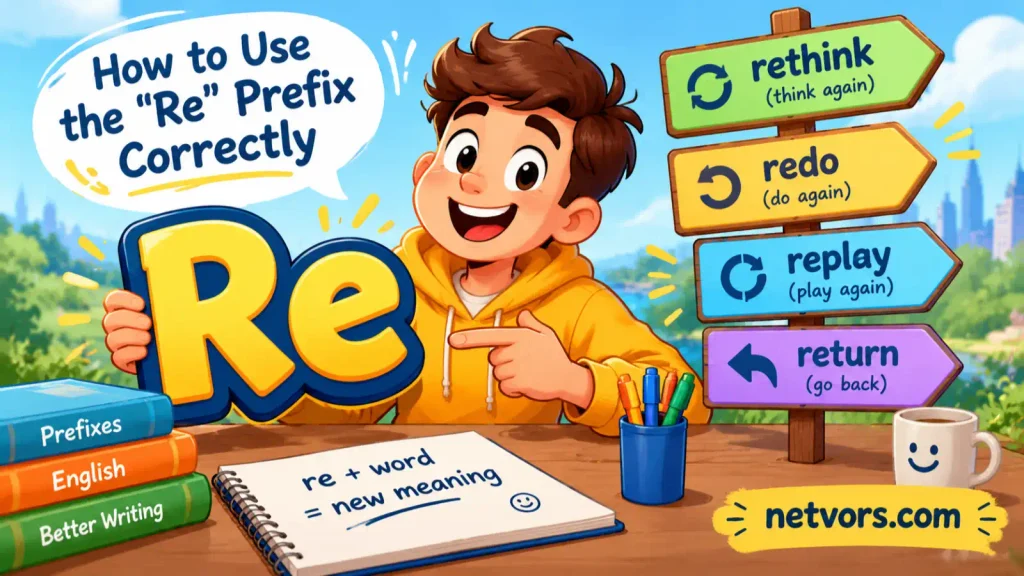
Understanding the re prefix meaning isn’t just about memorizing definitions—it’s about knowing when adding re- actually makes sense.
Use It When Something Happens Again
This is the most common usage.
Examples:
- Revisit
- Retry
- Reapply
- Reopen
- Recheck
Sentence examples:
- I’ll recheck the report before sending it.
- We need to retry the download.
- She plans to revisit Italy next year.
Here, every action is being performed another time.
Use It When Something Returns

Sometimes re- means bringing something back.
Examples:
- Restore
- Return
- Recover
- Reconnect
- Reclaim
Example sentences:
- The museum restored the old painting.
- We finally reconnected after many years.
- The company recovered from financial losses.
Instead of repeating an action, these words involve returning to an earlier condition.
Common Words Using the “Re” Prefix
Here are some of the most common examples you’ll encounter.
| Word | Meaning |
|---|---|
| Rewrite | Write again |
| Replay | Play again |
| Rebuild | Build again |
| Reuse | Use again |
| Reopen | Open again |
| Repaint | Paint again |
| Reinstall | Install again |
| Restart | Start again |
| Recharge | Charge again |
| Relearn | Learn again |
| Reconsider | Think again |
| Reorganize | Organize again |
Notice the consistent pattern? Once you understand the prefix, the meanings become much easier to guess.
When You Shouldn’t Add “Re-“
One common mistake among English learners is assuming re- can be attached to any verb.
It can’t.
For example:
Rewrite
Replay
Repaint
But not:
Reeat
Resleep
Redrink (except in very specific contexts)
English follows usage patterns that developed naturally over time. If a re- word sounds unfamiliar, it’s best to check a dictionary before using it.
“Re:” in Emails Is Different
One area that often confuses people is seeing “Re:” in email subject lines.
For example:
Re: Project Update
Many people assume it means regarding.
That’s actually a common misconception.
Historically, Re: comes from the Latin word in re, meaning “in the matter of” or “concerning.” In modern email systems, Re: is automatically added to indicate a reply to an existing email conversation.
So while the re prefix meaning in English words usually means again or back, Re: in email subjects serves a different purpose.
Example:
Original:
Project Update
Reply:
Re: Project Update
It simply shows the message belongs to the same conversation thread.
Is the “Re” Prefix Formal or Informal?
The prefix itself is neutral.
You’ll find it everywhere:
- School assignments
- Scientific writing
- Business reports
- Legal documents
- News articles
- Everyday conversations
- Social media
Because it’s part of standard English vocabulary, it’s appropriate in both formal and informal communication.
Tips for Remembering the Re Prefix Meaning
A simple memory trick is:
Think “Repeat” and “Return.”
If a word involves either repeating an action or returning to an earlier state, there’s a good chance the prefix re- fits perfectly.
For example:
- Repeat
- Recycle
- Reheat
- Reconnect
- Reuse
- Rebuild
Once you recognize this pattern, you’ll quickly expand your vocabulary and understand unfamiliar words with greater confidence.
Here’s Part 2 of your article.
Real-Life Examples of Words Using the Re Prefix
One of the easiest ways to understand the re prefix meaning is by seeing it in real conversations. The prefix re- usually tells you that an action is happening again or that something is returning to a previous state.
Below are several everyday scenarios where these words appear naturally.
Between Friends
Alex: “I accidentally deleted my essay.”
Sam: “That hurts! You’ll have to rewrite it before tomorrow.”
Meaning: Rewrite means to write again because the original version was lost.
At Work
Manager: “There are a few errors in the report.”
Employee: “No problem. I’ll recheck everything before sending the final copy.”
Meaning: Recheck means to check again to make sure everything is correct.
Family Conversation
Mom: “The leftovers are in the fridge.”
Son: “Great! I’ll reheat them for dinner.”
Meaning: Reheat means to heat something again after it has cooled.
During Online Gaming
Player 1: “Did you see that incredible final round?”
Player 2: “Absolutely! I’m going to replay the match.”
Meaning: Replay means to play or watch something again.
At School
Teacher: “Some students didn’t understand today’s lesson.”
Student: “Could we review the chapter tomorrow?”
Meaning: Review means to study something again to improve understanding.
While Traveling
Traveler: “Paris was amazing.”
Friend: “I’d love to revisit it someday.”
Meaning: Revisit means to visit again.
Using Technology
User: “My app keeps crashing.”
Support Agent: “Please restart your phone and try again.”
Meaning: Restart means to start something again after stopping it.
These examples show that the prefix re- keeps the same core idea across many different situations: again or back.
Common Mistakes & Misunderstandings
Although the re prefix meaning is fairly simple, people still make mistakes—especially English learners and those who confuse it with email terminology.
Here are the most common misunderstandings.
1. Thinking Every “Re-” Word Means Exactly the Same Thing
Many learners believe every word beginning with re- simply means “again.”
While that’s often true, some words lean more toward the idea of returning or restoring.
Examples:
- Return → go back
- Restore → bring back
- Recover → become healthy again
- Reconnect → connect again after losing contact
Understanding the context helps you choose the correct meaning.
2. Assuming You Can Add “Re-” to Any Verb
Not every English verb accepts the prefix.
Correct:
- Repaint
- Replay
- Rewrite
- Recharge
Incorrect (in standard English):
- Reeat
- Resleep
- Rewalk (unless used in a very specific context)
When in doubt, check whether the word appears in a dictionary.
3. Confusing “Re:” in Emails with the Prefix “Re-“
This is one of the biggest misunderstandings online.
Many people think:
Re = Regarding
Although people often explain it that way, email Re: is traditionally connected with the Latin phrase in re, meaning “in the matter of.” Modern email programs automatically use it to indicate a reply.
Meanwhile, the re- in words like rewrite or replay is an English prefix meaning again or back.
The two are related historically but serve different purposes.
Generational Differences
Younger generations usually encounter re- through technology-related words such as:
- Repost
- Rewatch
- Replay
- Reboot
- Reload
Older generations may be more familiar with traditional words like:
- Return
- Restore
- Rebuild
- Recover
- Reconsider
Regardless of age, the underlying meaning remains remarkably consistent.
Regional and Cultural Differences
Because English is spoken worldwide, some re- words are more common in certain countries.
For example:
- Reprogramme is common in British English.
- Reprogram is more common in American English.
Similarly:
- Reorganisation (UK)
- Reorganization (US)
The spelling changes, but the prefix keeps the same meaning.
How to Explain the Prefix to Someone Else
If someone asks what re- means, a simple explanation works best:
“It usually means doing something again or bringing something back.”
That single sentence covers the vast majority of English words using this prefix.
Re Prefix Across Different Contexts
Unlike internet slang or texting abbreviations, the re prefix appears almost everywhere in modern English. From classrooms to offices and social media feeds, you’ll encounter it every day.
Here’s how it’s commonly used in different settings.
In Education
Teachers often introduce prefixes to help students expand their vocabulary.
Common classroom examples include:
- Rewrite
- Review
- Relearn
- Recalculate
- Reevaluate
Learning prefixes allows students to understand unfamiliar words more easily without memorizing every definition.
In Business
Professionals use re- words constantly.
Examples include:
- Reorganize the team
- Reapprove the budget
- Reissue an invoice
- Reassess the proposal
- Reconsider the offer
These words sound natural and professional because they’re part of standard business English.
On Social Media
Modern technology has created many new re- words.
Popular examples include:
- Repost
- Rewatch
- Reload
- Reupload
- Recreate
- Remix
Creators and influencers use these words every day across platforms like TikTok, Instagram, YouTube, and X.
For example:
“This video was so funny that I had to rewatch it!”
In Technology
Software and computer terminology relies heavily on the prefix.
You’ll often see instructions such as:
- Restart your computer.
- Reinstall the software.
- Reconnect to Wi-Fi.
- Reload the webpage.
- Reset your password.
If you’ve ever solved a technical issue, you’ve probably followed one of these instructions.
Is the Re Prefix Formal or Informal?
The answer is simple:
It’s both.
You’ll find re- words in:
- Academic writing
- Scientific research
- Legal documents
- Newspapers
- Casual conversations
- Text messages
- Online forums
- Workplace emails
Because it’s a grammatical prefix rather than slang, it’s perfectly acceptable in every level of English.
Why Is It So Common?
The reason is efficiency.
Instead of creating a completely new word, English simply adds re- to an existing verb.
For example:
- Build → Rebuild
- Start → Restart
- Use → Reuse
- Read → Reread
- Think → Rethink
This makes new vocabulary easy to understand, even if you’ve never seen the word before.
The re prefix meaning follows a predictable pattern, making it one of the most valuable building blocks in the English language.
Related Prefixes, Similar Terms & Alternatives
While the re prefix meaning usually indicates “again” or “back,” English has many other prefixes that change a word’s meaning in different ways. Learning these can help you expand your vocabulary even faster.
Related Prefixes
| Prefix | Meaning | Example | Definition |
|---|---|---|---|
| re- | Again; back | Rewrite | Write again |
| un- | Not; reverse | Undo | Reverse an action |
| pre- | Before | Preview | View beforehand |
| post- | After | Postgraduate | After graduation |
| mis- | Wrongly | Misunderstand | Understand incorrectly |
| over- | Too much | Overcook | Cook too much |
| under- | Too little | Underestimate | Estimate too low |
| co- | Together | Cooperate | Work together |
| inter- | Between | Interact | Act between people |
| trans- | Across; beyond | Transport | Carry across |
Similar Words That Use the Re- Prefix
Here are some of the most common re- words you’ll encounter in everyday English:
- Rebuild – Build again after damage.
- Reconnect – Connect again after being disconnected.
- Reconsider – Think about something again.
- Recreate – Create again or copy something.
- Rediscover – Find something again after losing or forgetting it.
- Redo – Do something again.
- Refresh – Make something new or updated.
- Reload – Load something again.
- Renew – Make something new again.
- Replace – Put one thing in the place of another.
Synonyms for the Idea of “Re-“
Depending on the context, words with re- often relate to ideas such as:
- Repeat
- Return
- Restore
- Revive
- Resume
- Restart
- Renew
Opposite Ideas
Some words express the opposite meaning of re-, including:
- Stop
- Remove
- End
- Delete
- Abandon
- Cancel
- Destroy
Understanding both similar and opposite terms helps you recognize how prefixes shape the meaning of English words.
FAQs:
What does the re prefix mean?
The re prefix usually means “again” or “back.” It is added to the beginning of many English words to show that an action is repeated or that something returns to a previous state. Examples include rewrite, replay, rebuild, and restore.
Is re always a prefix?
No. In most English words, re- functions as a prefix. However, “Re:” in an email subject line is different. It indicates that the email is part of an existing conversation or reply rather than serving as a word prefix.
What language does the re prefix come from?
The prefix comes from Latin, where it originally meant “back” or “again.” Over time, it became one of the most widely used prefixes in English and appears in thousands of everyday words.
Can every English verb use the re prefix?
No. Although many verbs accept re-, not all do. Words like rewrite, repaint, and restart are standard English, while forms such as reeat or resleep are generally not accepted in normal usage.
Why is the re prefix so common?
The prefix allows English speakers to create clear and efficient words without inventing completely new vocabulary. Once you know that re- usually means again or back, it’s much easier to understand unfamiliar words when you encounter them.
Conclusion:
The re prefix meaning is simple, but it’s incredibly powerful. In most cases, re- means “again” or “back,” allowing English speakers to express repeated actions or a return to an earlier state with just two letters.
From everyday words like rewrite, restart, and rebuild to modern terms such as repost and rewatch, this prefix appears across conversations, education, technology, business, and digital communication. Once you understand the pattern, you’ll recognize the meaning of countless English words almost instantly.
The next time you come across a word beginning with re-, pause for a second and ask yourself: Does this mean “again” or “back”? In most cases, you’ll have your answer.
What’s your favorite English word that starts with “re-“? Share it in the comments below and continue exploring more English prefixes and language guides to build your vocabulary even further!

Hi, I’m John Cate, the voice behind Netvors.com, where I turn confusing words into clear meaning.
I’ve always been fascinated by how language evolves. One day a word means one thing, the next day it means something completely different, especially online. That shift is exactly what inspired me to build Netvors: a space where meanings are simple, accurate, and actually useful.