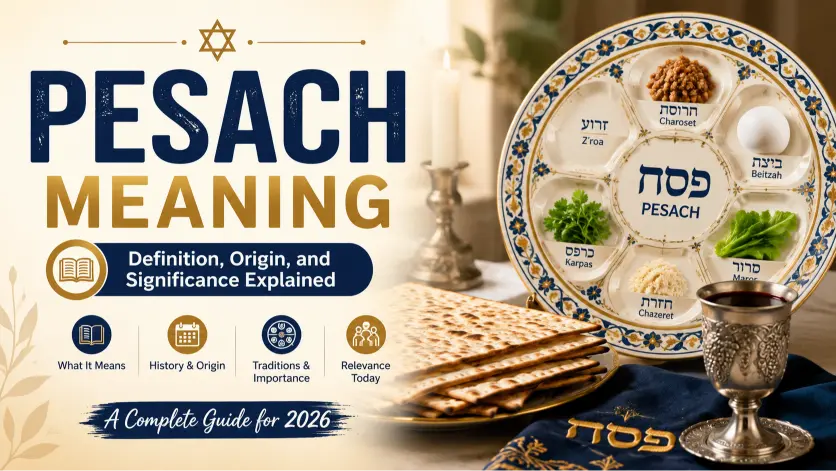
Have you ever seen the word Pesach on a holiday calendar, in a Bible, or mentioned by Jewish friends and wondered if it’s simply another word for Passover?
Many people search for Pesach meaning because they want to understand not only what the word means but also why it’s one of the most important celebrations in Judaism.
Whether you’re studying religion, attending a Passover dinner, helping your child with schoolwork, or simply curious about Jewish traditions, understanding Pesach opens the door to one of history’s most meaningful stories of freedom and faith.
Updated for 2026, this guide explains everything in simple English. You’ll learn the definition, pronunciation, biblical origin, traditions, modern usage, examples, and common misconceptions without confusing religious jargon.
What Does Pesach Meaning Mean?
Pesach is the Hebrew word for Passover, a major Jewish holiday celebrating the Israelites’ freedom from slavery in ancient Egypt. The word means “to pass over” because, according to the Book of Exodus, God passed over the homes of the Israelites during the final plague.
Origin of the Word Pesach
The word Pesach (פֶּסַח) comes from the Hebrew verb pasach, meaning:
- to pass over
- to spare
- to protect
According to the Book of Exodus, the Israelites marked their doorposts with lamb’s blood as instructed by God.
During the tenth plague, God “passed over” these homes while the plague affected the Egyptians.
That event became the foundation of the annual celebration known as Pesach.
Historical Background

The story of Pesach takes place in ancient Egypt.
According to the Hebrew Bible:
- The Israelites had been enslaved for centuries.
- Moses asked Pharaoh to free them.
- Pharaoh repeatedly refused.
- God sent ten plagues upon Egypt.
- After the final plague, Pharaoh allowed the Israelites to leave.
- Their hurried departure meant they had no time to let bread rise, leading to the tradition of eating matzah (unleavened bread).
This journey from slavery to freedom remains the heart of Pesach today.
How the Meaning Has Evolved

Originally, Pesach referred specifically to the biblical sacrifice offered before the Exodus.
Over time, the meaning expanded to include:
- the holiday itself
- the Seder meal
- family traditions
- remembering God’s protection
- celebrating freedom
- teaching children about Jewish history
Today, many people use Pesach and Passover interchangeably.
Pronunciation Guide
Many English speakers are unsure how to pronounce Pesach.
The most common pronunciation is:
PEH-sakh
Breaking it down:
- PEH (rhymes with “bed”)
- sakh (the final sound is similar to the German “Bach” or Scottish “loch”)
English speakers often pronounce it as PEH-sock because the Hebrew sound doesn’t exist in English. Both are widely understood.
Pronunciation: PEH-sakh
Why Is Pesach Important?
Pesach is much more than a holiday.
It represents universal themes that people of many faiths appreciate:
- freedom over oppression
- hope during difficult times
- family traditions
- gratitude
- remembering history
- faith and resilience
Because of these themes, the story of Passover has influenced literature, politics, civil rights movements, and religious traditions across the world.
How to Use Pesach Correctly
Although Pesach isn’t internet slang, it’s important to know when to use it appropriately.
In Everyday Conversation
You might hear:
“We’re celebrating Pesach with our grandparents this year.”
“Happy Pesach!”
“Our synagogue is preparing for Pesach.”
These are all natural uses.
In Writing
Examples include:
- Pesach begins at sunset.
- Families gather for the Pesach Seder.
- Many people avoid eating leavened bread during Pesach.
On Different Platforms
Text Messages
Happy Pesach! Hope you have a wonderful Seder tonight.
Are you hosting Pesach this year?
Celebrating family, freedom, and tradition. Happy Pesach! ✡️
People often post family photos from the Seder table alongside reflections on gratitude and freedom.
Discussions commonly focus on:
- recipes
- traditions
- family customs
- travel during Passover
- historical questions
- biblical interpretations
When NOT to Use Pesach
Avoid using Pesach:
- as a casual replacement for Easter
- as a joke or meme
- without understanding its religious significance
- interchangeably with unrelated holidays
Pesach specifically refers to the Jewish Passover and should be treated respectfully.
Formatting Tips
Capitalize Pesach
Capitalize Passover
Use “Happy Pesach!” as a greeting.✔ Spell Hebrew words consistently throughout your writing.
Avoid unnecessary abbreviations or slang when discussing religious topics.
Real Conversation Examples Using Pesach
Understanding the definition is helpful, but seeing Pesach used in real conversations makes it much easier to remember. Here are several everyday examples from different situations.
Between Friends
Emma: Are you free this weekend?
Noah: I’m spending the weekend with my family because it’s Pesach.
Emma: That’s nice! Happy Pesach to you and your family.
What it conveys
Here, Pesach simply refers to the Jewish holiday. The conversation is warm, respectful, and friendly.
Family Conversation
Dad: Don’t forget to pick up the matzah before everyone arrives.
Son: I already did. We’re ready for the Pesach Seder tonight.
Dad: Perfect!
What it conveys
The word Pesach naturally refers to the holiday celebration and family traditions.
Workplace Chat
Manager: Just a reminder I’ll be out of the office tomorrow.
Employee: Enjoy your Pesach celebration!
Manager: Thank you! Have a great week.
What it conveys
Using “Pesach” in professional conversations is perfectly appropriate when acknowledging someone’s holiday. Keep the tone respectful and sincere.
School Discussion
Teacher: Does anyone know why Jews celebrate Pesach?
Student: It remembers when the Israelites were freed from slavery in Egypt.
Teacher: Exactly.
What it conveys
Here, Pesach is used in an educational context to discuss history and religion.
Social Media Caption
Celebrating family, freedom, tradition, and gratitude. Happy Pesach to everyone observing! ✨🍷🥖
What it conveys
On social media, Pesach is often paired with messages of gratitude, family gatherings, and holiday wishes.
Community Event
Neighbor: Are you going to the community Seder this year?
Friend: Yes! We celebrate Pesach there every spring.
What it conveys
The word is commonly used when discussing religious or community events related to Passover.
Common Mistakes & Misunderstandings
Although Pesach is straightforward, many people misunderstand its meaning or use it incorrectly. Here are the most common mistakes.
1. Thinking Pesach and Easter Are the Same Holiday
This is probably the biggest misconception.
While Pesach and Easter often occur around the same time of year, they are different religious observances with distinct histories, beliefs, and traditions.
- Pesach commemorates the Exodus of the Israelites from Egypt.
- Easter celebrates the resurrection of Jesus in Christianity.
The two holidays are historically connected but not interchangeable.
2. Assuming Pesach Is a Different Holiday from Passover
Many people believe Pesach and Passover are separate celebrations.
They’re actually the same holiday.
- Pesach = Hebrew name
- Passover = English name
Using either term is generally acceptable, though Jewish communities often prefer “Pesach.”
3. Mispronouncing the Word
Many English speakers say:
- Pee-sack
- Pee-sach
- Pee-shack
The traditional pronunciation is:
PEH-sakh
However, many English-speaking Jewish communities understand and accept slightly simplified pronunciations.
Generational Differences
Older generations may be more familiar with the English word Passover.
Younger Jewish families, Hebrew learners, and people involved in Jewish education increasingly use Pesach in everyday conversation.
Neither is wrong—the choice often depends on personal preference and community tradition.
Cultural Differences
Usage varies around the world.
Israel
Almost everyone says Pesach because Hebrew is the primary language.
United States
You’ll hear both Passover and Pesach, sometimes even within the same conversation.
United Kingdom
Both terms are common, although Passover appears more frequently in general English.
Other Countries
English-speaking communities usually recognize both names, while local languages may have their own translations.
tion is usually enough.
Pesach Across Different Platforms & Demographics
Although Pesach is an ancient Hebrew word, people discuss it in many modern digital spaces. The way it’s used often depends on the platform and audience.
Gen Z
Gen Z users often mention Pesach in:
- Instagram Stories
- TikTok videos
- Snapchat posts
- family celebration photos
- recipe videos
- holiday humor
Many posts combine traditional customs with modern trends, making the holiday more accessible to younger audiences.
Millennials
Millennials frequently share:
- Seder table photos
- cooking tips
- family gatherings
- parenting experiences
- reflections on gratitude and freedom
Facebook and Instagram remain popular platforms for these posts.
Older Generations
Older adults often discuss Pesach through:
- synagogue newsletters
- community groups
- email greetings
- local events
- printed holiday materials
Their conversations tend to emphasize tradition and religious observance.
TikTok
TikTok has introduced many non Jewish viewers to Pesach traditions.
Popular videos include:
- preparing matzah recipes
- setting the Seder table
- explaining symbolic foods
- family traditions
- educational history lessons
Short, engaging clips have helped younger audiences learn about Passover in an accessible way.
Instagram posts often feature:
- beautifully decorated Seder tables
- traditional meals
- family portraits
- holiday blessings
- spring celebrations
Captions frequently include messages about freedom, faith, gratitude, and togetherness.
Facebook remains a hub for:
- community announcements
- synagogue events
- holiday greetings
- family albums
- educational articles
Many people also share memories from previous Pesach celebrations.
Reddit discussions are usually more detailed.
Popular topics include:
- preparing for Pesach
- recipes
- kosher food
- biblical history
- religious questions
- travel during Passover
- family traditions around the world
Users often compare customs from different Jewish communities and answer questions from those learning about the holiday.
Safe for Work?
Yes.
The term Pesach is completely safe for:
- schools
- workplaces
- educational websites
- business communications
- public presentations
When acknowledging someone’s observance, a simple “Happy Pesach!” is considered a thoughtful and respectful greeting.
Has Pesach Become More Visible Online?
Yes.
In recent years, interest in Pesach has grown across digital platforms due to:
- educational creators explaining Jewish holidays
- recipe and cooking content
- interfaith learning
- increased cultural awareness
- online community events and livestreamed Seders
As a result, more people now search for Pesach meaning to better understand the holiday, its traditions, and its historical importance.
Related Terms, Synonyms & Alternatives
If you’re learning about Pesach meaning, these related words and phrases will help you better understand the holiday and Jewish traditions.
| Term | Simple Definition | Internal Link Opportunity |
|---|---|---|
| Passover | The English name for Pesach. | Learn more about Passover Meaning |
| Seder | A ceremonial meal held on the first nights of Pesach. | Learn more about Seder Meaning |
| Haggadah | The book read during the Seder that tells the Exodus story. | Learn more about Haggadah Explained |
| Matzah (Matzo) | Unleavened bread eaten during Pesach. | Learn more about Matzah Meaning |
| Exodus | The biblical story of the Israelites leaving Egypt. | Learn more about Exodus Story |
| Kosher for Passover | Foods prepared according to Passover dietary laws. | Learn more about Kosher Meaning |
| Chametz | Leavened food avoided during Pesach. | Learn more about Chametz Explained |
| Moses | The biblical leader who led the Israelites out of Egypt. | Learn more about Who Was Moses? |
| Freedom | The central theme celebrated during Pesach. | Learn more about Meaning of Freedom |
| Passover Lamb | A symbolic part of the original Passover story. | Learn more about Passover Lamb Meaning |
FAQs:
What does Pesach literally mean?
Pesach literally means “to pass over.” It comes from the Hebrew verb pasach, referring to God passing over the homes of the Israelites during the final plague in Egypt, as described in the Book of Exodus.
Is Pesach the same as Passover?
Yes. Pesach is the Hebrew name, while Passover is the English translation. Both names refer to the same Jewish holiday celebrating the Exodus from Egypt.
Why is Pesach important?
Pesach remembers the Israelites’ liberation from slavery in Egypt. Beyond its historical significance, the holiday teaches lessons about freedom, faith, hope, gratitude, justice, and remembering one’s heritage.
Can non-Jewish people celebrate Pesach?
Many non-Jewish people attend a Pesach Seder as guests to learn about Jewish history and traditions. If invited, it’s respectful to observe the customs, ask thoughtful questions, and appreciate the holiday’s religious significance.
Why is matzah eaten during Pesach?
According to the Exodus story, the Israelites left Egypt so quickly that they didn’t have time to let their bread rise. Matzah symbolizes that hurried departure and serves as a reminder of the journey from slavery to freedom.
Conclusion:
Understanding Pesach meaning is about much more than learning the definition of a single word. It’s about discovering a holiday that has represented freedom, faith, family, and hope for thousands of years.
Whether you call it Pesach or Passover, the celebration continues to bring people together through storytelling, shared meals, and traditions that connect generations. Learning its history and symbolism helps you appreciate one of the world’s oldest and most meaningful religious observances.
If this guide helped you understand Pesach meaning, keep exploring related cultural and language topics to deepen your knowledge.

Hi, I’m John Cate, the voice behind Netvors.com, where I turn confusing words into clear meaning.
I’ve always been fascinated by how language evolves. One day a word means one thing, the next day it means something completely different, especially online. That shift is exactly what inspired me to build Netvors: a space where meanings are simple, accurate, and actually useful.