Have you ever stumbled across the word “pooka” in a fantasy novel, Halloween discussion, folklore documentary, or social media post and wondered what it actually means?
You’re not alone. The term has appeared in mythology books, movies, TV shows, gaming communities, and online discussions for years. Yet many people still aren’t sure whether a pooka is a fairy, a monster, a spirit, or something else entirely.
Understanding the pooka meaning matters because folklore continues to influence modern storytelling, internet culture, fantasy gaming, and even everyday conversations about myths and legends. The pooka remains one of the most fascinating supernatural figures from Celtic tradition.
In this guide, you’ll learn what a pooka is, where the legend originated, how its meaning evolved over time, how it appears in modern media, and the most common misconceptions surrounding this mysterious creature.
Updated for 2026.
Table of Contents
- What Does “Pooka” Mean?
- How the Pooka Appears in Folklore
- Real Examples of Pooka Legends
- Common Mistakes & Misunderstandings
- Pooka Across Modern Media & Demographics
- Related Mythological Creatures
- Frequently Asked Questions
- Conclusion
What Does “Pooka” Mean? (Definition + Origin)
Quick Answer: A pooka is a supernatural shape-shifting spirit from Irish and Celtic folklore known for trickery, unpredictable behavior, and magical transformations.
The pooka meaning comes from Irish mythology, where the creature is known as Púca. It belongs to a class of supernatural beings associated with the fairy world, though it differs significantly from the tiny winged fairies often shown in popular culture.
A pooka can take many forms, including:
- Black horse
- Goat
- Rabbit
- Dog
- Human-like figure
- Hybrid creature
Unlike purely evil monsters, the pooka is usually portrayed as unpredictable. One encounter might end with helpful advice, while another could involve a frightening prank.
Origin of the Word
The word comes from the Irish term Púca, which has roots in Celtic folklore dating back hundreds of years.
Related words appear across Europe:
- Irish: Púca
- Welsh: Pwca
- Cornish: Bucca
These variations generally describe supernatural spirits or goblin-like beings capable of causing mischief.
Pronunciation Guide
Pooka: POO-kuh
Púca: POO-kah
Both pronunciations are widely accepted in English-language discussions.
How the Meaning Has Evolved
Historically, the pooka was viewed as a mysterious countryside spirit.
Today, the term may refer to:
- A mythological creature
- A fantasy character archetype
- A magical trickster figure
- A supernatural shape-shifter in books, films, and games
Modern interpretations often soften the creature’s darker aspects and emphasize its playful nature.
How the Pooka Appears in Folklore
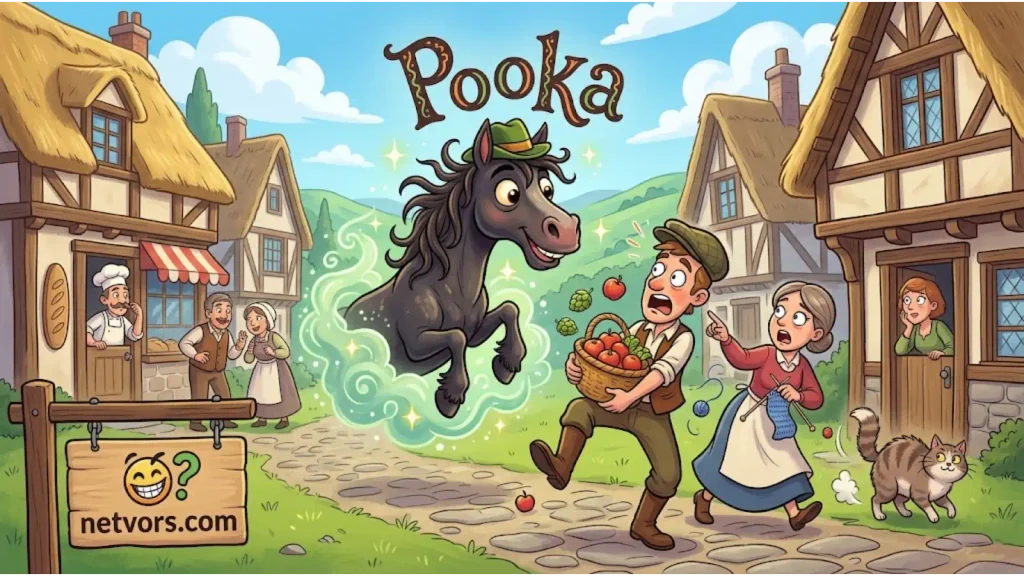
Traditional stories describe the pooka as one of the most feared and respected supernatural beings in Ireland.
The Shape-Shifter
The pooka’s defining trait is transformation.
A single pooka might appear as:
- A horse at night
- A rabbit in a field
- A stranger on a road
- A shadowy figure near a village
This unpredictability made encounters especially unsettling.
Trickster Behavior
Many legends portray the pooka as a prankster.
Examples include:
- Leading travelers off course
- Frightening livestock
- Speaking unexpectedly
- Creating confusion for amusement
Yet these tricks rarely had purely malicious intentions.
Helpful Side of the Pooka
Some stories describe the pooka giving:
- Warnings
- Prophecies
- Advice
- Hidden knowledge
This dual nature is what makes the creature so fascinating.
Connection to Harvest Traditions
In some Irish traditions, a portion of the harvest was left untouched as the “Pooka’s Share.”
The practice reflected respect for supernatural forces believed to influence crops and fortune.
Real Examples of Pooka Legends
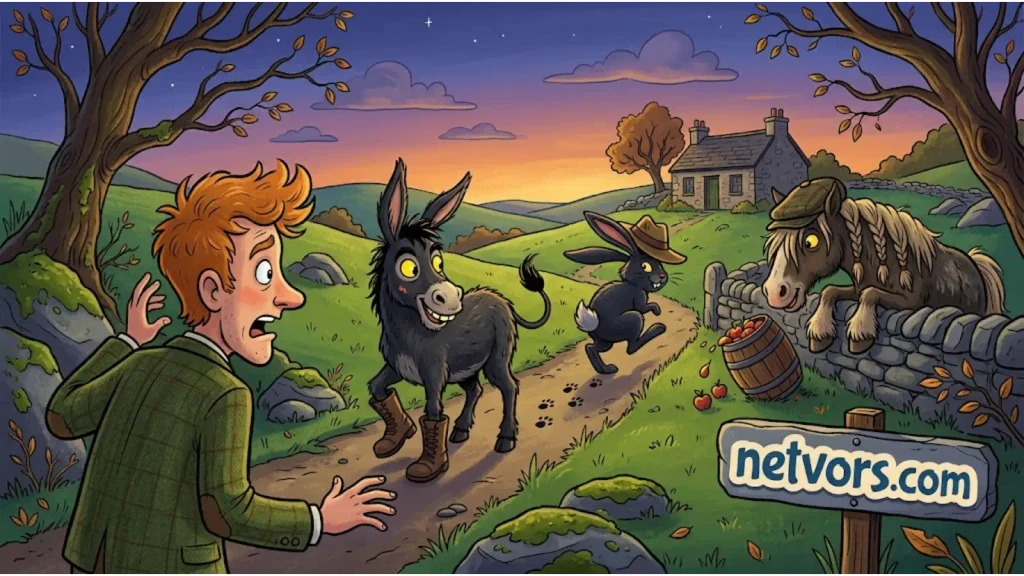
Below are common storytelling scenarios featuring pookas.
Example 1: The Midnight Rider
Context: Rural Irish folklore
Villager: “I saw a black horse standing alone.”
Friend: “Did you ride it?”
Villager: “I did. It carried me across the countryside before vanishing.”
Meaning: The pooka often appears as a horse that takes unsuspecting riders on terrifying journeys.
Example 2: The Talking Rabbit
Context: Woodland encounter
Traveler: “That rabbit just spoke to me.”
Companion: “Then it may not be a rabbit at all.”
Meaning: Shape-shifting and unexpected speech are classic pooka traits.
Example 3: The Helpful Warning
Context: Village folklore
Farmer: “A strange figure warned me about tomorrow’s storm.”
Neighbor: “Then you may have met a pooka.”
Meaning: Not all encounters end negatively; some stories present the creature as a messenger.
Example 4: The Mischievous Trick
Context: Local legend
Villager: “Someone moved all my tools overnight.”
Friend: “Sounds like pooka behavior.”
Meaning: Practical jokes are frequently associated with the creature.
Example 5: Modern Gaming Discussion
Context: Online gaming chat
Player 1: “That NPC reminds me of a pooka.”
Player 2: “Yeah, always changing forms and causing chaos.”
Meaning: Modern fantasy communities often use the term to describe trickster characters.
Common Mistakes & Misunderstandings
The pooka definition is frequently misunderstood.
Mistake #1: Assuming It’s Evil
Many people classify the pooka as a demon or monster.
Folklore paints a more nuanced picture. The creature is unpredictable rather than purely malevolent.
Mistake #2: Confusing It with Generic Fairies
A pooka belongs to the broader world of Celtic supernatural beings, but it is not simply another fairy.
It has unique traits:
- Shape-shifting
- Trickery
- Animal forms
- Strong folklore identity
Mistake #3: Thinking Every Story Is the Same
Different regions describe pookas differently.
Some portray them as frightening.
Others emphasize humor and wisdom.
Generational Differences
Older folklore enthusiasts often know the traditional legends.
Younger audiences may recognize pookas from:
- Fantasy novels
- Video games
- Anime
- Online mythology discussions
Cultural Differences
Irish audiences generally connect the creature to folklore and heritage.
International audiences often encounter it through entertainment media first.
Pooka Across Modern Media & Demographics
The pooka has experienced a modern revival.
Among Gen Z
Gen Z often encounters the term through:
- Fantasy TikTok content
- Mythology explainers
- Role-playing games
- Character design communities
The creature’s shape-shifting abilities make it especially popular in creative fandoms.
Among Millennials
Millennials frequently recognize the pooka from:
- Fantasy literature
- Tabletop RPGs
- Online gaming culture
- Mythology documentaries
Among Older Generations
Older audiences are more likely to connect the term directly to Irish folklore and traditional storytelling.
Social Media Presence
The pooka appears regularly in:
TikTok
Short mythology videos and folklore storytelling.
Fantasy art and creature illustrations.
Discussions about Celtic mythology and supernatural legends.
Discord
Role-playing servers and fantasy world-building communities.
Is It Formal or Informal?
The term itself is neutral.
However, discussions about pookas are usually:
- Educational
- Historical
- Entertainment-focused
- Fantasy-related
It is perfectly acceptable in academic discussions about mythology.
Related Slang, Abbreviations & Alternatives
While the pooka is not internet slang, readers interested in mythology often explore similar supernatural beings.
| Term | Meaning |
|---|---|
| Fairy | Broad category of magical beings |
| Banshee | Irish spirit associated with warnings of death |
| Leprechaun | Irish folklore figure linked to treasure |
| Kelpie | Shape-shifting water spirit from Scottish folklore |
| Goblin | Mischievous mythical creature |
| Pixie | Small magical being from folklore |
| Brownie | Helpful household spirit |
| Changeling | Fairy child exchanged for a human child |
| Selkie | Seal-human shape-shifter |
| Trickster Spirit | General term for magical pranksters |
Related reading opportunities:
- Learn more about banshee meaning
- Explore kelpie folklore
- Discover leprechaun origins
- Read about changeling myths
- Understand Celtic fairy traditions
FAQs:
Is a pooka a fairy?
A pooka is often categorized within Celtic fairy folklore, but it differs from the tiny winged fairy image common in popular culture. It is generally portrayed as a shape-shifting supernatural spirit with its own distinct characteristics.
Can a pooka change shape?
Yes. Shape-shifting is one of the defining features of the pooka. Stories describe transformations into horses, rabbits, goats, dogs, and even human-like forms.
Are pookas dangerous?
Some legends portray them as frightening or troublesome, while others show them helping humans. Most folklore presents them as unpredictable rather than entirely dangerous.
Is the pooka based on a real creature?
No evidence suggests the pooka was based on a real animal. It is considered a mythological figure that developed through centuries of folklore and storytelling.
Why is the pooka still popular today?
The pooka combines mystery, humor, transformation, and supernatural power. Those traits make it appealing for fantasy writers, game developers, artists, and mythology enthusiasts.
What does Púca mean in Irish?
Púca is the original Irish spelling and refers to the same supernatural shape-shifting spirit found throughout Irish folklore and mythology.
Conclusion:
The pooka meaning goes far beyond a simple mythical creature. It represents one of the most memorable supernatural figures in Irish and Celtic folklore—a shape-shifting spirit known for mystery, mischief, and unpredictability.
Unlike purely heroic or villainous characters, the pooka exists somewhere in between. It can help, trick, warn, or frighten people depending on the story being told.
That complexity is exactly why the legend has survived for centuries and continues to inspire books, games, movies, and online discussions today.
Have a favorite mythological creature or folklore legend? Share it in the comments and keep exploring the fascinating world of Celtic mythology.

Hi, I’m John Cate, the voice behind Netvors.com, where I turn confusing words into clear meaning.
I’ve always been fascinated by how language evolves. One day a word means one thing, the next day it means something completely different, especially online. That shift is exactly what inspired me to build Netvors: a space where meanings are simple, accurate, and actually useful.