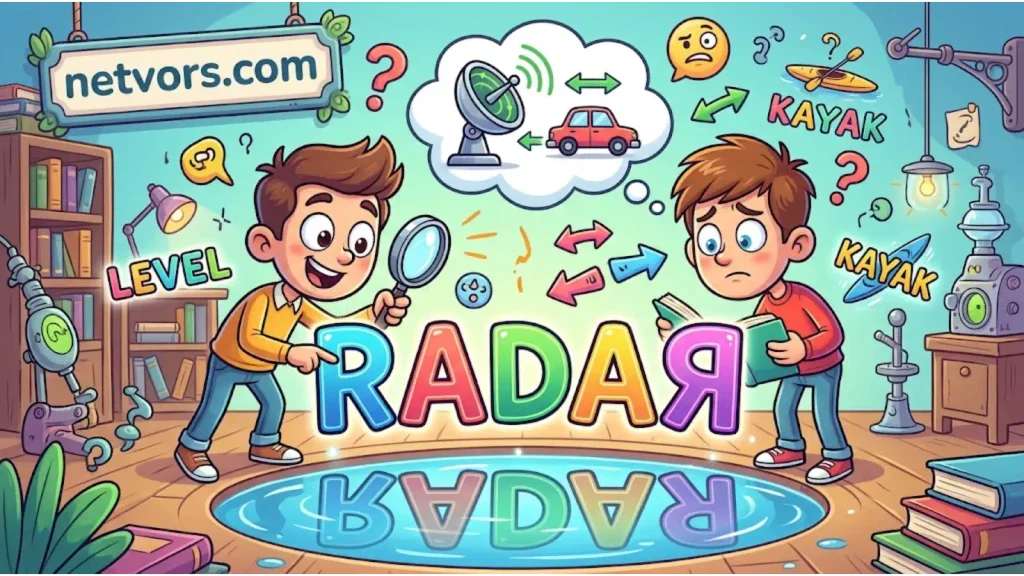
Have you ever noticed that the word level looks exactly the same when you read it backward? Or that the number 121 remains unchanged whether you read it from left to right or right to left? These little language surprises are more than coincidences. They are examples of a fascinating pattern called a palindrome.
Understanding the palindromic meaning helps you recognize this pattern in words, numbers, sentences, and even scientific sequences. You might encounter it while solving a word puzzle, learning English vocabulary, exploring mathematics, or reading about DNA. Although the term may sound technical, the idea behind it is surprisingly simple.
This guide explains what palindromic means, where the word comes from, how it differs from palindrome, and how to identify palindromic patterns in everyday examples. You will also discover common mistakes, interesting facts, and answers to frequently asked questions.
Updated for 2026: This guide covers the meaning, practical examples, and major applications of palindromic patterns.
What Does Palindromic Mean?

The word palindromic is an adjective that describes something that reads the same forward and backward, according to the rules used for that particular word, number, phrase, or sequence.
For example, radar is palindromic because reversing its letters produces the same word. Similarly, 121 is a palindromic number because its digits remain in the same order when reversed.
Quick Answer: Palindromic Meaning
Palindromic means having a pattern that remains the same when read forward or backward. The term commonly describes words such as level, numbers such as 121, and phrases such as “Never odd or even,” when spaces and punctuation are ignored.
What Is the Difference Between Palindrome and Palindromic?
These two words are closely related, but they serve different grammatical purposes.
- Palindrome: A noun referring to a word, number, phrase, or sequence that reads the same backward and forward.
- Palindromic: An adjective describing something that has the characteristics of a palindrome.
Consider these examples:
- “Radar is a palindrome.”
- “Radar is a palindromic word.”
- “The number 1331 has a palindromic pattern.”
All three sentences communicate the same general idea, but each uses the terminology differently.
Where Does the Word Palindromic Come From?
The word palindromic comes from palindrome, which traces back to the Greek elements palin, meaning “again” or “back,” and dromos, meaning “course” or “running.”
Together, the elements suggest moving or running back along the same course. This origin reflects the defining feature of a palindrome: its reading pattern works in both directions.
The term entered English through scholarly and literary use and became associated with wordplay, poetry, puzzles, and linguistic patterns.
There is no single social media platform or modern internet trend responsible for its origin. Palindromes have a much longer history than texting, Instagram, TikTok, or online slang.
How Has the Meaning Evolved?
The central meaning has remained consistent, but its applications have expanded.
Originally associated mainly with language and literary wordplay, palindromic patterns are now discussed in mathematics, programming, genetics, and other technical fields.
For instance, a puzzle enthusiast might search for palindromic words, while a mathematician might study palindromic numbers. A biology student might encounter the term when learning about DNA sequences.
The underlying concept stays the same: a pattern is compared with its reverse.
How Do You Pronounce Palindromic?
Palindromic is commonly pronounced pal-in-DROM-ik, with the main stress on “DROM.”
The related noun, palindrome, is pronounced PAL-in-drohm.
Knowing the pronunciation can help when discussing word puzzles, giving a classroom presentation, or explaining the concept to someone unfamiliar with the term.
How to Use Palindromic Correctly in Writing and Conversation

Palindromic is a descriptive word rather than a texting abbreviation or internet slang expression. You can use it whenever you want to explain that a word, number, phrase, or sequence has the same pattern when reversed.
In Everyday Conversation
Use the word when discussing language, puzzles, numbers, or anything with a reversible pattern.
Examples:
- “Level is a palindromic word.”
- “My puzzle asks me to find a palindromic number.”
- “That sentence has a palindromic structure.”
- “The sequence looks palindromic when read from either direction.”
You do not need to use the term in casual conversation unless it adds useful detail. Saying “radar reads the same backward” is perfectly clear, too.
In Text Messages and Online Chats
You can use palindromic in messages, group chats, social media posts, and online discussions. However, it is not a widely recognized texting abbreviation like LOL or BRB.
For example:
Friend 1: I found a word that looks the same backward.
🫠Friend 2: Is it a palindrome?
Friend 1: Yep! “Civic” is palindromic.
This exchange uses the term naturally because the conversation is about wordplay.
On Instagram, Reddit, Discord, or other platforms, people may use the term when sharing puzzles, unusual words, number patterns, or educational content. That does not mean the word has a special platform-specific definition.
In Academic and Professional Writing
Palindromic is suitable for formal writing when it accurately describes the subject.
Examples include:
- “The researcher identified a palindromic sequence in the dataset.”
- “Students were asked to generate palindromic numbers.”
- “The program checks whether an input string is palindromic.”
In mathematics and computer science, the term can be especially useful because it describes a specific property precisely.
Capitalization, Punctuation, and Tone
The word is normally written in lowercase: palindromic.
Capitalize it at the beginning of a sentence or when it appears in a title using title case. There is no special punctuation rule for the word itself.
You can also use it playfully:
“Level, radar, and civic? English has some seriously symmetrical moments!”
The tone can be educational, humorous, or technical depending on the surrounding sentence.
Real Examples of Palindromic Words, Numbers, and Phrases
The easiest way to understand the meaning is to see how the pattern works in different situations.
1. Common Palindromic Words
Words are the most familiar examples.
| Word | Reversed spelling | Why it qualifies |
|---|---|---|
| Level | Level | Letters remain identical |
| Radar | Radar | The reversed spelling is unchanged |
| Civic | Civic | The letter order is symmetrical |
| Madam | Madam | It reads identically backward |
| Refer | Refer | Reversing the letters changes nothing |
| Noon | Noon | The sequence is the same in both directions |
| Rotator | Rotator | The full letter sequence is reversible |
These examples are useful for spelling exercises, vocabulary lessons, word games, and brain teasers.
2. Palindromic Numbers
A number is palindromic when its digits appear in the same order from either direction.
Examples include:
- 7: A single-digit number is palindromic.
- 121: Reversing the digits produces 121.
- 777: The digits are identical in either direction.
- 1331: The reversed digit sequence remains 1331.
- 12321: The digits form a symmetrical pattern.
Palindromic numbers often appear in mathematical puzzles and recreational mathematics. Some people also enjoy spotting them on clocks, receipts, and vehicle registration numbers.
However, seeing a palindromic number does not automatically give it a spiritual or predictive meaning. Such interpretations depend on personal beliefs rather than the mathematical definition.
3. Palindromic Phrases and Sentences
A palindrome can contain more than one word.
Consider the familiar phrase:
“Never odd or even.”
When spaces are removed and the letters are compared without regard to capitalization, the phrase reads the same in either direction.
Another classic example is:
“A man, a plan, a canal: Panama!”
This phrase is palindromic when punctuation, spaces, and capitalization are ignored.
Such examples demonstrate why a palindrome is not always immediately obvious. You need to examine the underlying sequence rather than simply reverse the visible words.
4. Palindromic Patterns in a Friendship Chat
Friend 1: Give me a word that reads the same backward.
🫠Friend 2: Radar.
Friend 1: Nice! What about level?
Friend 2: Also a palindrome. English just handed us a tiny brain teaser.
What it conveys: The term adds a precise name to a fun discovery and keeps the conversation lighthearted.
5. Palindromic Numbers in a Group Chat
Friend 1: My lucky number is 121.
🫠Friend 2: Did you choose it because it’s palindromic?
Friend 1: I noticed that afterward!
What it conveys: Here, palindromic describes the number’s structure. Any personal significance attached to the number is separate from its mathematical property.
6. Palindromic Words in a Classroom
Student: Is “madam” a palindrome?
Teacher: Yes. Ignore the capitalization, reverse the letters, and you get the same word.
Student: So “palindromic” is the adjective?
Teacher: Exactly. You can say “a palindromic word.”
What it conveys: This example shows how the noun and adjective differ in ordinary educational conversation.
7. Palindromic Patterns in Programming
Developer 1: The input is “1221.” Does the function recognize it?
Developer 2: Yes. It compares the input with its reversed version.
Developer 1: Great. Then we can classify it as palindromic.
What it conveys: In a technical setting, the word describes a testable property rather than an informal expression or emotional tone.
Common Mistakes and Misunderstandings
Although the concept is simple, a few common errors can cause confusion.
Mistake 1: Confusing Palindromic With Palindrome
A palindrome is the thing itself; palindromic describes its property.
Incorrect: “Level is a palindromic.”
Better: “Level is a palindrome.”
Also correct: “Level is a palindromic word.”
The distinction is grammatical, not a difference in the underlying concept.
Mistake 2: Assuming Every Repeated Pattern Is a Palindrome
A word with repeated letters is not necessarily palindromic.
For example, apple contains repeated letters, but reversing it produces elppa. The result is different.
A palindrome requires the entire relevant sequence to remain unchanged when reversed. Repetition alone is not enough.
Mistake 3: Ignoring the Rules for Spaces and Punctuation
For phrases, spaces and punctuation are commonly ignored. Capitalization is usually ignored as well.
That is why “Never odd or even” qualifies despite its spaces.
However, the comparison rules can vary by application. A computer program may treat uppercase and lowercase letters differently unless it is designed to ignore case. Similarly, a number’s leading zeros may affect how a particular system evaluates it.
Always establish which characters count before deciding whether something is palindromic.
Do Different Generations Interpret the Word Differently?
There is no strong reason to assume that Gen Z, Millennials, or older generations assign different core meanings to palindromic. It is an established English adjective, not a generation-specific slang term.
A younger audience might encounter it in online puzzles or educational videos, while an older audience might recognize it from literature or mathematics. Individual familiarity varies.
If someone does not understand the term, simply explain: “It means the same when you read it backward.”
Are There Cultural or Regional Differences?
The general concept is widely used in language and mathematics, but specific examples depend on the writing system and language.
A palindrome that works in English may not work when translated into another language. Some writing systems also have different rules for characters, accents, and spacing.
Therefore, it is best to evaluate a palindrome according to the language and conventions in which it is written.
Palindromic Meaning Across Platforms, Age Groups, and Fields
Palindromic does not have a special definition on any major social media platform. Its meaning remains the same across contexts, although the situations in which people encounter it can differ.
TikTok and Instagram
On short-form video and image-sharing platforms, palindromes can make entertaining educational content. Creators might challenge viewers to find reversible words, show interesting numbers, or present a phrase that works in both directions.
A caption such as “Can you name three palindromic words?” can invite people to participate in the puzzle.
These are examples of possible uses, not evidence that the word is currently trending or that a particular platform made it popular.
Discord, Reddit, and Online Communities
Puzzle communities, language-learning groups, mathematics forums, and programming communities may use palindromic to describe a challenge or a technical property.
For example, a coding challenge could ask participants to determine whether a string is palindromic. A word-game community might share a list of unusual palindromes.
The meaning is consistent, even when the context changes.
Gen Z, Millennials, and Older Generations
The word is not inherently associated with any age group.
- Gen Z: May encounter it in online challenges, short videos, or word games.
- Millennials: May use it in puzzles, educational content, writing, or technical discussions.
- Older generations: May recognize it through traditional wordplay, books, mathematics, or language education.
These are possible exposure patterns, not fixed generational rules. Anyone can learn and use the term.
Is Palindromic Formal or Informal?
Palindromic is appropriate in both casual and formal contexts.
It is safe for work, has no inherently offensive meaning, and is suitable for classroom discussions, reports, and professional communication when relevant.
Its technical sound may make it feel formal, but the concept itself is accessible to beginners.
Palindromic Patterns Beyond Everyday Language
The word has several important applications outside word games.
Mathematics: Palindromic numbers have digit sequences that remain unchanged when reversed. They can be explored through arithmetic, number puzzles, and programming exercises.
Computer science: A common programming exercise checks whether a string or number is palindromic. This helps learners practise string manipulation, comparisons, and algorithms.
Biology: Certain DNA sequences have palindromic properties under the appropriate biological definition. These patterns can be relevant to molecular recognition and the study of restriction enzymes. DNA palindromes require careful treatment of complementary strands, so they are not always equivalent to simply reversing a printed string of letters.
Literature: Writers can use palindromes as wordplay, constraints, or memorable lines. Creating a long, natural-sounding palindrome is much harder than finding a short one.
Related Terms, Synonyms, and Alternatives
Understanding related vocabulary makes it easier to explain the concept accurately.
| Term | Meaning | Example or use |
|---|---|---|
| Palindrome | A word, number, phrase, or sequence that reads the same backward and forward | “Radar” is a palindrome |
| Reversible | Capable of being reversed; not necessarily unchanged after reversal | A reversible process |
| Symmetrical | Having corresponding parts arranged in a balanced way | A symmetrical design |
| Mirror image | A reflection that resembles an object in reverse | Letters can appear reversed in a mirror |
| Wordplay | Creative or playful use of language | A puzzle based on word patterns |
| Anagram | A word or phrase formed by rearranging letters | “Listen” and “silent” |
| Sequence | An ordered series of items or symbols | A sequence of digits |
| Palindromic number | A number whose digits read the same backward and forward | 1331 |
| Palindromic sequence | A sequence that matches its reverse under defined comparison rules | A reversible string |
| Symmetry | A property involving balanced or corresponding structure | Symmetry in geometry |
What Are the Closest Synonyms for Palindromic?
There is no perfect synonym in every context. Words such as reversible and symmetrical may convey a related idea, but they do not necessarily mean that a sequence remains identical when reversed.
If you are explaining a palindrome to a beginner, try:
- “It reads the same backward.”
- “Its letters match in reverse order.”
- “The pattern is identical in both directions.”
These expressions are often clearer than substituting a loosely related technical word.
Is There an Antonym for Palindromic?
There is no single widely established antonym for palindromic that fits every use.
Depending on the context, you could say non-palindromic to describe a sequence that does not read the same backward and forward.
For example, apple is non-palindromic because reversing its letters changes the sequence.
FAQs:
1. What does palindromic mean in simple words?
Palindromic means that something reads the same from left to right and right to left. The word level is a simple example. The number 121 also qualifies because its digits remain unchanged when reversed. For phrases, spaces, punctuation, and capitalization are usually ignored, depending on the rules being applied.
2. What is the difference between a palindrome and palindromic?
A palindrome is a noun that names the word, phrase, number, or sequence that reads the same backward and forward. Palindromic is an adjective describing something with that property. You can say “Radar is a palindrome” or “Radar is a palindromic word.” Both are correct.
3. What are five examples of palindromic words?
Five common examples are level, radar, civic, madam, and refer. Each word retains the same spelling when its letters are reversed. You can use these examples in vocabulary lessons, word puzzles, spelling activities, and conversations about interesting features of English.
4. Is 121 a palindromic number?
Yes. The number 121 is palindromic because reversing its digits produces 121 again. Other examples include 7, 777, 1331, and 12321. Palindromic numbers are commonly used in mathematics exercises and number puzzles because their symmetrical digit patterns are easy to recognize.
5. Is palindromic a slang word?
No. Palindromic is a standard English adjective, not a texting abbreviation or a slang expression with a special internet meaning. People can use it in online chats and social media discussions, but its definition remains the same as in dictionaries and academic writing.
6. Can a full sentence be palindromic?
Yes. A sentence can be palindromic when its letters read identically in reverse after spaces, punctuation, and capitalization are ignored. “Never odd or even” is a well-known example. Constructing longer palindromic sentences can be challenging because the words must form a meaningful sentence while satisfying the reversal rule.
7. What does palindromic mean in mathematics?
In mathematics, palindromic commonly describes a number or sequence of digits that remains unchanged when reversed. For instance, 1331 is a palindromic number. The term is useful in number puzzles, recreational mathematics, and programming tasks involving the comparison of digit sequences.
8. What does palindromic mean in biology?
In biology, palindromic often describes a DNA sequence with a particular reverse-complement relationship. Because DNA has complementary strands, biological palindromes are not always identified by simply reading one printed sequence backward. The term is relevant to molecular biology, including the recognition of certain DNA sites by restriction enzymes.
9. Is every symmetrical word a palindrome?
No. Symmetry is a broader concept, and a word can look visually balanced without reading identically backward. A palindrome must satisfy a specific sequence rule. For example, apple contains repeated letters but is not a palindrome because reversing its letters produces a different sequence.
10. How can I tell if a word is palindromic?
Write the word, reverse the order of its letters, and compare the result with the original. If both are identical, the word is palindromic. For phrases, remove spaces and punctuation first if the rules allow it. In programming, the same check can be automated with a short function.
Conclusion:
The palindromic meaning is straightforward: something is palindromic when its sequence reads the same forward and backward under the relevant comparison rules. Words such as level, phrases such as “Never odd or even,” and numbers such as 121 demonstrate the concept.
The term is useful in everyday language, puzzles, mathematics, computer science, and biology. Remember the grammatical difference, too: a palindrome is the pattern itself, while palindromic describes it.
Now that you know what palindromic means, try finding five examples of your own. Share your favorite palindrome with a friend, use one in a word puzzle, or explore more language guides to discover how fascinating ordinary words can be.

Hi, I’m John Cate, the voice behind Netvors.com, where I turn confusing words into clear meaning.
I’ve always been fascinated by how language evolves. One day a word means one thing, the next day it means something completely different, especially online. That shift is exactly what inspired me to build Netvors: a space where meanings are simple, accurate, and actually useful.