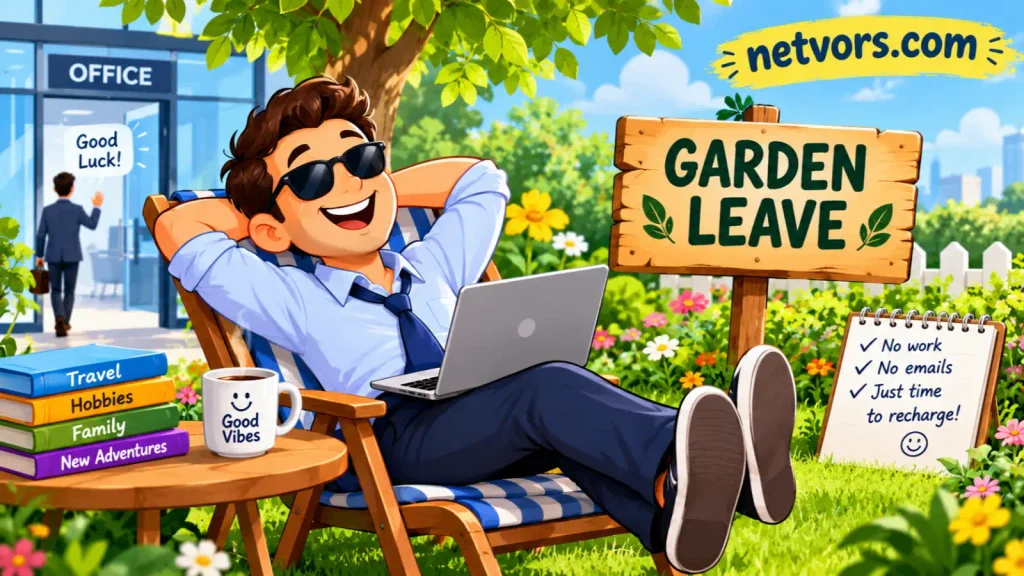
Imagine you resign from your job, expecting to spend your final two weeks finishing projects, saying goodbye to colleagues, and handing over your responsibilities. Instead, your manager tells you to stay home until your official last day while continuing to receive your salary.
Surprisingly, you still work for the company on paper, even though you are no longer doing your usual job. Welcome to the world of garden leave.
Understanding the garden leave meaning is especially useful if you are changing jobs, working in a competitive industry, or trying to understand your employment rights. The term often appears in employment contracts, resignation discussions, HR emails, and conversations about leaving a company.
But does garden leave mean you can relax at home? Can you start working for a new employer? And can your company legally stop you from working elsewhere?
This guide explains what garden leave means, where the expression comes from, how it works, and what employees should check before making their next career move. It also explores practical examples, common misconceptions, and differences between countries.
Updated for 2026: This guide provides general employment information. Your rights depend on your contract and the law that applies to your employment.
What Does “Garden Leave” Mean? (Definition and Origin)
Garden leave is a workplace arrangement in which an employee remains employed during a notice period but is usually instructed not to perform their normal duties or attend the workplace.
The employee generally continues to receive their regular salary and contractual benefits until employment officially ends, subject to the contract and applicable law.
Think of it as being on the company payroll while being asked to stay away from the office.
Quick Answer: What Is Garden Leave?
Garden leave is a period during which an employee who is leaving a company remains employed and usually gets paid but is instructed not to work normally or attend the workplace until their employment ends.
It is commonly used when an employee resigns or an employer gives notice of termination, particularly when the person has access to sensitive information, business strategies, or important customer relationships.
Where Did the Term “Garden Leave” Come From?
The expression is associated with British employment culture. It humorously suggests that an employee has been sent home with time to tend their garden rather than continue working during their notice period.
The term is also known as gardening leave, particularly in the United Kingdom and other English-speaking employment contexts.
There is no single social media platform or viral moment responsible for the expression. It developed in workplace and employment usage rather than internet slang.
How Has the Meaning Evolved?
Garden leave has become a familiar term in discussions about job changes, executive departures, financial services, technology companies, and other competitive industries.
Today, people may use it in several ways:
- In HR: To describe a formal employment arrangement during notice.
- In career discussions: To explain why someone is temporarily unavailable to join a new company.
- In everyday conversation: To say that a departing employee is being paid to stay away from work.
The central idea remains the same: the person is still employed, but their usual work duties are suspended or restricted.
Is Garden Leave Formal or Informal?
Garden leave is an employment term, not casual internet slang. It is appropriate in professional discussions, HR correspondence, employment documents, and conversations with recruiters.
Pronunciation: GAR-den leave.
The phrase is usually written in lowercase unless it appears at the beginning of a sentence or in a heading.
How Does Garden Leave Work in Practice?
Garden leave generally starts after an employee resigns or receives notice of termination, when the employer decides that the person should not continue performing their normal duties.
The exact arrangement varies, but the process often follows these steps:
- Notice is given. The employee resigns or receives notice from the employer.
- The employer confirms the arrangement. The employee is told whether garden leave applies and what restrictions are in place.
- Normal duties stop or change. The employee may be asked to stay home, surrender company equipment, or stop contacting clients.
- Employment continues. Salary and applicable contractual benefits generally continue during the notice period.
- Employment ends. The employee reaches their official termination date and can move on, subject to any surviving contractual obligations.
An employer does not automatically have the right to impose every restriction in every situation. The employment contract, local law, and circumstances matter.
Why Do Employers Use Garden Leave?
Employers may use garden leave to protect legitimate business interests when an employee is leaving.
Common reasons include:
- Protecting confidential information: Preventing further access to sensitive company records, plans, or financial data.
- Protecting client relationships: Reducing the risk that a departing employee will immediately transfer customers to a competitor.
- Managing competitive risks: Limiting access to information that could give another business an advantage.
- Supporting a smooth transition: Allowing the company to reorganize responsibilities while the employee remains employed.
- Reducing workplace disruption: Avoiding awkward situations when an employee is joining a direct competitor or leaving under difficult circumstances.
Garden leave is not necessarily a punishment. It can be a standard business measure, although being excluded from work may feel frustrating for the employee.
Do You Get Paid During Garden Leave?
In many arrangements, yes. An employee on garden leave typically continues to receive salary and applicable contractual benefits until the employment relationship ends.
However, the exact entitlements depend on the employment contract and local law. Benefits, bonuses, commissions, stock awards, pension contributions, holiday accrual, and other payments may have separate rules.
Before assuming that everything will continue unchanged, review the relevant contract terms and ask HR for written confirmation.
How to Use “Garden Leave” Correctly in Texts and Conversations
Although garden leave is not a slang abbreviation, it appears frequently in professional messages and everyday conversations about employment.
Use the expression when discussing a real employment arrangement rather than simply describing a holiday or a break between jobs.
Correct Contexts and Tone
| Context | Example |
|---|---|
| Professional | “My notice period includes four weeks of garden leave.” |
| Casual | “She’s on garden leave until the end of the month.” |
| Humorous | “Apparently, I’m being paid to water plants until my notice ends.” |
| Recruiter conversation | “My current employer has placed me on garden leave, so my start date depends on my official end date.” |
| HR communication | “Could you confirm my garden leave arrangements and final employment date?” |
The term is neutral and professional. It does not automatically imply that an employee has done something wrong.
Garden Leave in SMS and WhatsApp
In text messages, the expression is often used to explain why someone is not going to the office or cannot start a new position immediately.
Example:
“Finally resigned! I’m on garden leave for the next month, so I’ll have some time to sort things out.”
The message conveys a job transition and a temporary period away from normal duties.
Garden Leave on Instagram and Other Social Platforms
Someone might mention garden leave in a career update or a humorous post about leaving a stressful job.
For example:
“New chapter loading. Currently on garden leave and enjoying a slower morning routine.”
The tone may be celebratory, but people should be careful about posting confidential details, criticizing their employer, or suggesting that contractual restrictions no longer apply.
Garden Leave in Workplace Chat
On platforms such as Slack, Microsoft Teams, or Discord workplace communities, the phrase may appear in discussions about notice periods, recruitment, and employment policies.
For example:
“Alex is on garden leave, so please direct outstanding project questions to Priya.”
This use is straightforward and professional.
When Should You Avoid Using the Term?
Avoid using garden leave as a substitute for unrelated employment situations.
For example, taking annual leave, going on unpaid leave, being temporarily laid off, or receiving a severance payment does not automatically mean someone is on garden leave.
In formal communication, use the term only when it accurately describes the arrangement. If the status is unclear, ask HR to confirm it.
Real Conversation Examples Using Garden Leave
These fictional examples show how the expression works in everyday professional and personal conversations.
1. Between Friends
Sam: “Why aren’t you going into the office anymore?”
Jamie: “I’m on garden leave until my notice period ends.”
Sam: “So you’re still employed?”
Jamie: “Yep, but I’m not doing my usual work.”
What it conveys: Jamie is explaining a temporary change in work status. The exchange highlights that being away from the office does not necessarily mean employment has ended.
2. In a Family Chat
Maya: “When does your new job start?”
Brother: “Not sure yet. I’ve got six weeks of garden leave.”
Maya: “Six weeks at home? That’s a lot of coffee breaks!”
What it conveys: The conversation uses light humor to describe time away from the workplace. Maya’s reaction is playful, but the notice period may still come with contractual restrictions.
3. With a Recruiter
Recruiter: “Could you start with us next Monday?”
Candidate: “I need to check my contract. I’m currently on garden leave, and my employment hasn’t officially ended.”
Recruiter: “Please confirm your earliest permitted start date.”
What it conveys: The employee is being careful about contractual obligations rather than assuming they can start a new position immediately.
4. In a Workplace Group Chat
Manager: “Who will handle Jordan’s client accounts this month?”
HR colleague: “Jordan is on garden leave, so please send all account queries to the interim team.”
What it conveys: Garden leave is being used as a neutral explanation for a change in responsibilities. It helps the team understand who should handle ongoing work.
5. Between Two Gamers Who Work Together
Riley: “You’re online at lunchtime again. Did you quit?”
Morgan: “Sort of. I’ve resigned, and I’m on garden leave until my last day.”
Riley: “So you’re temporarily the office-free champion?”
What it conveys: The friends use humor to describe a genuine employment arrangement. Being free to play games during the day does not, by itself, determine whether Morgan can take another job.
Common Garden Leave Mistakes and Misunderstandings
Garden leave is easy to misunderstand because it resembles a paid break but still involves an active employment relationship.
Mistake 1: Assuming Garden Leave Means You Have Been Fired
Garden leave does not necessarily mean dismissal. Employees who resign voluntarily may be placed on garden leave, and employers may also use it after giving notice of termination.
The important question is whether the employment relationship has ended. During garden leave, it generally has not.
Mistake 2: Thinking You Can Automatically Start a New Job
Being away from the office does not automatically release an employee from their existing obligations.
An employment contract may restrict outside work, competing activities, or the use of confidential information while employment continues. The rules vary by jurisdiction and contract.
Before accepting or starting another position, check the applicable terms and seek qualified advice if necessary.
Mistake 3: Confusing Garden Leave With Paid Holiday
Garden leave is not simply annual leave with a different name.
Annual leave is intended as time off under the applicable leave policy. Garden leave usually involves a decision by the employer to remove or restrict the employee’s normal duties during a notice period.
The treatment of unused holiday and whether leave can be taken during garden leave depends on the contract and local law.
Are There Generational or Cultural Differences?
The term is particularly familiar in British employment contexts. Someone who has not encountered it before may interpret it literally and imagine that the employee has been told to spend time gardening.
In other countries, the arrangement may be understood through local employment terminology rather than the exact phrase “garden leave.”
There is no reliable basis for claiming that a particular generation uses the term more frequently across all workplaces. Familiarity often depends more on industry, country, and professional experience than age.
How Can You Clarify the Meaning?
If someone mentions garden leave and you are unsure what they mean, ask a simple question:
“Do you mean you’re still employed and being paid during your notice period, but you don’t have to work?”
That question confirms the main idea without making assumptions about the person’s situation.
Garden Leave Across Different Platforms, Industries, and Demographics
Garden leave is primarily an employment term, so its usage depends more on professional circumstances than on social media trends.
Is Garden Leave Formal or Informal?
Garden leave is a formal employment concept that also appears in informal conversation.
| Setting | Typical use |
|---|---|
| HR documents | Describes employment status and restrictions during notice |
| Explains a career transition or availability | |
| Updates friends and family about leaving a job | |
| Appears in personal career updates or jokes | |
| May appear in discussions about contracts, resignation, and employment rights | |
| TikTok | May appear in workplace stories or career-related humor |
| Discord | Can appear in professional communities and work-related discussions |
These are examples of contexts in which the term may appear, not measured rankings of platform popularity.
How Do Different Age Groups Understand Garden Leave?
People who work in industries where notice periods and competitive restrictions are common may already understand the term.
Younger workers, recent graduates, or people entering their first professional role may need an explanation. Older workers may be familiar with the concept through years of employment experience, but age alone does not determine understanding.
For clear communication, define the term the first time you use it in a message intended for a broad audience.
Is Garden Leave Safe for Work?
Yes. Garden leave is a workplace-related expression and is generally safe for work, professional documents, and ordinary conversation.
However, discussing an individual’s garden leave publicly may reveal sensitive employment information. Consider privacy and confidentiality before sharing details about another person’s departure.
Has a Viral Trend Popularized Garden Leave?
Garden leave does not have one universally recognized viral origin. Its visibility often comes from employment discussions, career advice, workplace stories, and reports about executives or employees moving between competing companies.
It is better to understand the term as established workplace vocabulary than to treat it as a newly invented internet trend.
Garden Leave Rules: What Employees Should Know
The rules governing garden leave differ between countries and may depend on the employment contract, the employee’s role, and the reason for the arrangement.
For example, UK employment contracts may include an express garden leave clause. Other jurisdictions may apply different rules concerning notice, continued pay, outside employment, and enforceability.
Can an Employer Force You to Take Garden Leave?
The answer depends on the relevant employment agreement and local law.
Some contracts expressly allow an employer to place an employee on garden leave during notice. Where no clear contractual right exists, the employer’s ability to impose the arrangement may be more complicated.
Employees should not assume that a manager’s verbal instruction settles every legal question. Review the written contract and seek advice appropriate to the jurisdiction.
Can You Work for Another Company During Garden Leave?
Sometimes, but not automatically.
Because employment usually continues during garden leave, the employee may remain subject to contractual duties, confidentiality requirements, conflict-of-interest rules, and restrictions on outside work.
Starting work for a competitor can be particularly sensitive. The answer depends on the contract, the new role, and applicable law.
Does Garden Leave Count Toward Your Notice Period?
Usually, garden leave takes place during the notice period rather than extending it. The employee remains employed until the agreed or legally applicable termination date unless the arrangement is changed.
Check the written notice and employment documents to establish the exact final date.
Can You Be Contacted While on Garden Leave?
Possibly. Being placed on garden leave does not always mean an employee must avoid every work-related interaction.
An employer may request a limited handover, return of equipment, or clarification of outstanding matters, depending on the arrangement. Employees should follow reasonable, lawful instructions and ask for clarification if the expectations are unclear.
What Should You Check Before Leaving?
Review these points before agreeing to or acting on a garden leave arrangement:
- Your employment contract and any garden leave clause.
- The start and end dates of the notice period.
- Salary, benefits, bonuses, and holiday arrangements.
- Restrictions on working for another employer.
- Confidentiality and client-contact obligations.
- The process for returning equipment and company property.
- Any post-employment restrictions that continue after your last day.
If the financial or career consequences are significant, consider consulting an employment lawyer or an appropriate local advice service.
Garden Leave vs. Notice Period, Annual Leave, and Non-Compete Clauses
These terms are related but do not mean the same thing.
| Term | Meaning | Key difference |
|---|---|---|
| Garden leave | Employee remains employed but is generally kept away from normal duties | Usually takes place during notice |
| Notice period | Time between notice being given and employment ending | May involve normal work or garden leave |
| Annual leave | Approved time off under a leave entitlement | Primarily concerns holiday entitlement |
| Paid leave | A broad term for leave during which pay continues | Does not automatically involve garden leave |
| Unpaid leave | Time away from work without regular pay, subject to the arrangement | Pay treatment differs |
| Non-compete clause | A contractual restriction on certain competitive activities | May apply after employment ends, subject to applicable law |
| Severance pay | Payment associated with the end of employment in certain circumstances | Does not necessarily mean the employee is on garden leave |
| Suspension | Temporary removal from some or all work duties, often while a matter is investigated | Different purpose and circumstances |
| PILON | Payment in lieu of notice | In many arrangements, employment ends without the employee working the notice period, subject to contract and law |
Garden Leave vs. a Non-Compete Clause
This distinction is especially important when changing jobs.
Garden leave generally operates while the employee is still employed. A non-compete clause seeks to restrict certain competitive activities, often after employment ends.
The existence, duration, and enforceability of a non-compete restriction depend on the contract and the law governing the employment. Neither term should be assumed to apply universally.
Garden Leave vs. Payment in Lieu of Notice
Payment in lieu of notice, commonly called PILON, is generally a payment made instead of requiring the employee to work through some or all of the notice period.
With garden leave, employment ordinarily continues until the employment end date. With PILON, the employment relationship may end earlier, depending on the agreement and applicable law.
The practical difference can affect benefits, restrictions, and the date on which an employee may start a new job.
Related Employment Terms and Alternatives
If you are researching garden leave, these related terms can help you understand employment changes and notice arrangements.
| Related term | Brief definition |
|---|---|
| Notice period | The time between giving or receiving notice and the end of employment |
| Resignation | An employee’s formal decision to leave a job |
| Termination | The ending of an employment relationship |
| PILON | Payment in lieu of notice |
| Non-compete | A restriction on specified competitive activities |
| Confidentiality agreement | An agreement covering the protection or use of confidential information |
| Severance pay | A payment that may be provided when employment ends |
| Annual leave | Time off from work under an applicable holiday entitlement |
| Employment contract | An agreement setting out employment terms and obligations |
| Handover | The transfer of duties, information, and responsibilities to another person |
These are related employment concepts, not synonyms for garden leave.
Suggested related reading: Articles explaining notice periods, resignation letters, non-compete clauses, payment in lieu of notice, and employee termination rights would provide useful additional context.
FAQs:
1. What does garden leave mean in simple words?
Garden leave means that an employee is still employed by a company but is usually told not to attend work or carry out normal duties during some or all of their notice period. They generally continue receiving salary and applicable benefits until their employment ends. The exact rules depend on their contract and local employment law.
2. Why is it called garden leave?
The term comes from the humorous idea that an employee who is not allowed to work might stay at home tending their garden. It is associated with British employment terminology and is also called gardening leave. It does not literally mean that an employee must garden or take annual leave.
3. Do you get paid while on garden leave?
Employees generally continue to receive their regular salary and applicable contractual benefits while on garden leave. However, bonus schemes, commissions, holiday entitlements, and other benefits may be governed by separate rules. Review the employment contract and written garden leave instructions to confirm what applies to your situation.
4. Can I start a new job while on garden leave?
Not necessarily. You usually remain employed by your existing employer until the official end date, so restrictions on outside work, conflicts of interest, and confidentiality may continue to apply. Check your contract and seek legal advice where needed before accepting or starting a new role, particularly with a competitor.
5. Is garden leave the same as being fired?
No. Garden leave describes an arrangement in which an employee is kept away from normal duties while employment generally continues. It may follow a resignation or an employer’s notice of termination. The term itself does not establish whether the departure was voluntary, disciplinary, or related to redundancy.
6. How long can garden leave last?
Garden leave often lasts for some or all of an employee’s notice period. The length depends on the contract, the notice arrangement, and applicable law. There is no single worldwide maximum that applies to every employee. Check the stated end date and any relevant contractual provisions rather than assuming that every arrangement lasts one month or three months.
7. Is garden leave legal in every country?
No single rule applies worldwide. The availability and enforceability of garden leave depend on local employment law, the employment contract, and the circumstances. The arrangement is familiar in the United Kingdom, but employees in other countries should consult the rules applicable to their jurisdiction before assuming that a UK-style clause is valid or enforceable.
8. Can an employer cancel garden leave and ask me to return?
That depends on the contract, the terms of the arrangement, and applicable law. Some arrangements may permit the employer to change its instructions or request a return to work. If you receive conflicting directions, ask for written clarification about your duties, attendance requirements, pay, and employment end date.
9. What is the difference between garden leave and gardening leave?
They are alternative names for essentially the same employment arrangement. “Garden leave” is widely used, while “gardening leave” is also common, particularly in British English. Both describe a situation in which an employee remains employed but is generally kept away from their usual work during a notice period.
10. Does garden leave affect my CV or future employers?
Garden leave is not inherently a negative mark on your employment history. You can usually describe your role and employment dates accurately on your CV. If a recruiter asks about your availability, explain that you are serving a notice period under a garden leave arrangement and confirm your actual start date based on your contractual obligations.
Conclusion:
The garden leave meaning is straightforward: an employee remains employed, usually continues to receive pay, and is generally asked not to perform normal duties during a notice period. The arrangement is often used to protect confidential information and manage the risks associated with an employee’s departure.
Garden leave is not the same as being fired, taking annual leave, or automatically being free to join another employer. Your contract, employment end date, and local law determine the details that matter most.
If you are leaving a job, read your employment documents carefully and confirm any restrictions before making plans. And if you have encountered the term in a workplace conversation, you now know what it means.
Have you ever experienced garden leave or encountered the term in a job contract? Share your experience or questions in the comments, and explore more employment terminology to make your next career move with confidence.::

Hi, I’m John Cate, the voice behind Netvors.com, where I turn confusing words into clear meaning.
I’ve always been fascinated by how language evolves. One day a word means one thing, the next day it means something completely different, especially online. That shift is exactly what inspired me to build Netvors: a space where meanings are simple, accurate, and actually useful.