
“What exactly is a function?” You’re not alone. From middle school classrooms to advanced college courses, functions are one of the most important concepts in mathematics and one of the most misunderstood.
The function meaning in math goes far beyond memorizing a definition. Functions help describe relationships between numbers, predict outcomes, analyze data, and solve real-world problems. Whether you’re graphing equations, studying algebra, learning calculus, or preparing for an exam, understanding functions gives you a strong mathematical foundation.
The good news? Functions aren’t as complicated as they first appear. Once you understand the basic rule that each input has exactly one output the rest starts to make sense.
In this guide, you’ll learn what a function is, where the concept comes from, how to recognize one, how to use function notation, common mistakes to avoid, and plenty of real-world examples. By the end, you’ll be able to identify functions with confidence and understand why they’re one of the most essential ideas in mathematics.
What Does “Function” ?
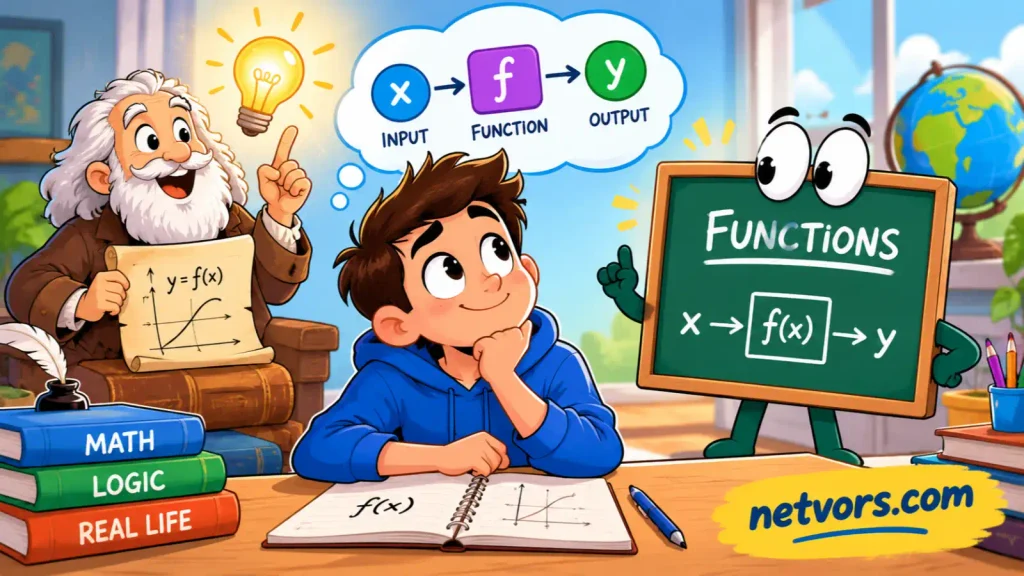
A function in mathematics is a special relationship between two sets where every input (also called the independent variable) has exactly one output (called the dependent variable).
Think of a function as a machine.
You put one value into the machine, and it gives you exactly one result. No matter how many times you enter the same input, you’ll always get the same output.
For example:
- Input: 2 → Output: 5
- Input: 3 → Output: 7
- Input: 4 → Output: 9
If the rule is:
f(x) = 2x + 1
Then every number has only one answer.
That makes it a function.
Quick Answer
A function in math is a rule that assigns exactly one output to every input. If one input produces more than one output, it is not considered a function.
Simple Definition
Imagine a vending machine.
You press one button.
You receive one snack.
Press the same button again.
You receive the same snack.
A function works the same way. One input always matches one output.
Pronunciation
Function
Pronounced as:
FUNK-shun
IPA:
/ˈfʌŋk.ʃən/
Where Did the Idea of Functions Come From
Although people have used mathematical relationships for thousands of years, the modern idea of a function developed during the 1600s and 1700s.
Mathematicians studying motion, astronomy, and geometry noticed that many quantities depended on other quantities.
For example:
- The distance a car travels depends on time.
- The area of a square depends on its side length.
- The cost of groceries depends on how many items you buy.
Later, famous mathematicians like Leonhard Euler helped formalize the notation we still use today, including expressions like:
f(x)
Today, functions are used in nearly every branch of mathematics, science, engineering, economics, artificial intelligence, and computer programming.
Why Functions Matter

Functions aren’t just classroom topics.
They describe how the real world works.
Examples include:
- Weather forecasting
- Population growth
- Stock market trends
- Mobile app algorithms
- Physics equations
- Machine learning models
- Video game mechanics
- Business profits
Whenever one quantity depends on another, there’s usually a function involved.
How to Use “Function” Correctly in Math
Students often hear the word “function” but aren’t sure when it’s appropriate to use it.
Here’s the simplest rule:
A relation is a function only if every input has exactly one output.
Let’s compare.
Example 1 (Function)
| Input | Output |
|---|---|
| 1 | 4 |
| 2 | 6 |
| 3 | 8 |
Each input appears only once.
This is a function.
Example 2 (Not a Function)
| Input | Output |
|---|---|
| 2 | 5 |
| 2 | 8 |
The same input (2) has two different outputs.
This is not a function.
Function Notation Explained
One of the first things students learn is function notation.
Instead of writing:
y = 2x + 3
you may see:
f(x) = 2x + 3
This simply means:
“The function named f takes x as the input.”
Let’s calculate.
If:
f(x) = 2x + 3
Then:
f(2)
= 2(2) + 3
= 7
Likewise,
f(5)
= 2(5) + 3
= 13
Notice that every input gives exactly one output.
Understanding Inputs and Outputs
Every function has two essential parts.
Input (Independent Variable)
The value you choose.
Usually written as:
x
Output (Dependent Variable)
The answer produced by the function.
Usually written as:
y or f(x)
Example:
Input = 6
Rule:
Multiply by 3.
Output = 18
Written mathematically:
f(6) = 18
Domain and Range
Two words you’ll frequently encounter are domain and range.
Domain
The set of all possible input values.
Example:
If:
f(x) = x²
The domain includes every real number because any real number can be squared.
Range
The set of all possible outputs.
For:
f(x)=x²
Outputs cannot be negative.
Therefore:
Range:
0, 1, 4, 9, 16…
and every positive decimal between.
Different Ways Functions Are Represented
One reason functions seem confusing is that they appear in several forms.
Fortunately, they’re all describing the same idea.
1. Equation
Example:
f(x)=3x−1
Most common in algebra.
2. Table
| x | y |
|---|---|
| 1 | 2 |
| 2 | 5 |
| 3 | 8 |
| 4 | 11 |
Tables help identify patterns quickly.
3. Graph
A graph visually shows how inputs relate to outputs.
If every vertical line touches the graph only once, the graph represents a function.
This is known as the Vertical Line Test, which you’ll learn more about later.
4. Mapping Diagram
Input → Output
1 → 4
2 → 6
3 → 8
Mapping diagrams make it easy to see whether every input has exactly one output.
Real Examples of Functions
Understanding functions becomes much easier when you connect them to everyday life.
Example 1: Shopping
Each notebook costs $4.
Function:
Cost = 4 × Number of notebooks
Buy:
- 1 notebook → $4
- 3 notebooks → $12
- 8 notebooks → $32
Each quantity produces exactly one total price.
That’s a function.
Example 2: Taxi Fare
A taxi charges:
$5 starting fee
Plus
$2 per mile
Function:
Fare = 5 + 2m
Drive:
5 miles
Fare = $15
Every distance gives one fare.
Example 3: Temperature Conversion
Converting Celsius to Fahrenheit follows a fixed rule:
F = (9/5 × C) + 32
If:
20°C
Then:
68°F
Every Celsius temperature converts to one Fahrenheit temperature.
Example 4: Test Scores
Suppose a teacher assigns grades based on percentage.
85%
Always becomes
Grade B
Every score has one grade.
This grading rule is another example of a function.
Example 5: Area of a Square
Formula:
Area = side²
If the side length is:
6 cm
Area:
36 cm²
Each side length corresponds to one area.
Another perfect example of a mathematical functio
What Does “Function” Mean in Math?
A function in mathematics is a special relationship between two sets where every input (also called the independent variable) has exactly one output (called the dependent variable).
Think of a function as a machine.
You put one value into the machine, and it gives you exactly one result. No matter how many times you enter the same input, you’ll always get the same output.
For example:
- Input: 2 → Output: 5
- Input: 3 → Output: 7
- Input: 4 → Output: 9
If the rule is:
f(x) = 2x + 1
Then every number has only one answer.
That makes it a function.
Quick Answer
A function in math is a rule that assigns exactly one output to every input. If one input produces more than one output, it is not considered a function.
Simple Definition
Imagine a vending machine.
You press one button.
You receive one snack.
Press the same button again.
You receive the same snack.
A function works the same way. One input always matches one output.
Pronunciation
Function
Pronounced as:
FUNK-shun
IPA:
/ˈfʌŋk.ʃən/
Where Did the Idea of Functions Come From?
Although people have used mathematical relationships for thousands of years, the modern idea of a function developed during the 1600s and 1700s.
Mathematicians studying motion, astronomy, and geometry noticed that many quantities depended on other quantities.
For example:
- The distance a car travels depends on time.
- The area of a square depends on its side length.
- The cost of groceries depends on how many items you buy.
Later, famous mathematicians like Leonhard Euler helped formalize the notation we still use today, including expressions like:
f(x)
Today, functions are used in nearly every branch of mathematics, science, engineering, economics, artificial intelligence, and computer programming.
Why Functions Matter
Functions aren’t just classroom topics.
They describe how the real world works.
Examples include:
- Weather forecasting
- Population growth
- Stock market trends
- Mobile app algorithms
- Physics equations
- Machine learning models
- Video game mechanics
- Business profits
Whenever one quantity depends on another, there’s usually a function involved.
How to Use “Function” Correctly in Math
Students often hear the word “function” but aren’t sure when it’s appropriate to use it.
Here’s the simplest rule:
A relation is a function only if every input has exactly one output.
Let’s compare.
Example 1 (Function)
| Input | Output |
|---|---|
| 1 | 4 |
| 2 | 6 |
| 3 | 8 |
Each input appears only once.
This is a function.
Example 2 (Not a Function)
| Input | Output |
|---|---|
| 2 | 5 |
| 2 | 8 |
The same input (2) has two different outputs.
This is not a function.
Function Notation Explained
One of the first things students learn is function notation.
Instead of writing:
y = 2x + 3
you may see:
f(x) = 2x + 3
This simply means:
“The function named f takes x as the input.”
Let’s calculate.
If:
f(x) = 2x + 3
Then:
f(2)
= 2(2) + 3
= 7
Likewise,
f(5)
= 2(5) + 3
= 13
Notice that every input gives exactly one output.
Understanding Inputs and Outputs
Every function has two essential parts.
Input (Independent Variable)
The value you choose.
Usually written as:
x
Output (Dependent Variable)
The answer produced by the function.
Usually written as:
y or f(x)
Example:
Input = 6
Rule:
Multiply by 3.
Output = 18
Written mathematically:
f(6) = 18
Domain and Range
Two words you’ll frequently encounter are domain and range.
Domain
The set of all possible input values.
Example:
If:
f(x) = x²
The domain includes every real number because any real number can be squared.
Range
The set of all possible outputs.
For:
f(x)=x²
Outputs cannot be negative.
Therefore:
Range:
0, 1, 4, 9, 16…
and every positive decimal between.
Different Ways Functions Are Represented
One reason functions seem confusing is that they appear in several forms.
Fortunately, they’re all describing the same idea.
1. Equation
Example:
f(x)=3x−1
Most common in algebra.
2. Table
| x | y |
|---|---|
| 1 | 2 |
| 2 | 5 |
| 3 | 8 |
| 4 | 11 |
Tables help identify patterns quickly.
3. Graph
A graph visually shows how inputs relate to outputs.
If every vertical line touches the graph only once, the graph represents a function.
This is known as the Vertical Line Test, which you’ll learn more about later.
4. Mapping Diagram
Input → Output
1 → 4
2 → 6
3 → 8
Mapping diagrams make it easy to see whether every input has exactly one output.
Real Examples of Functions
Understanding functions becomes much easier when you connect them to everyday life.
Example 1: Shopping
Each notebook costs $4.
Function:
Cost = 4 × Number of notebooks
Buy:
- 1 notebook → $4
- 3 notebooks → $12
- 8 notebooks → $32
Each quantity produces exactly one total price.
That’s a function.
Example 2: Taxi Fare
A taxi charges:
$5 starting fee
Plus
$2 per mile
Function:
Fare = 5 + 2m
Drive:
5 miles
Fare = $15
Every distance gives one fare.
Example 3: Temperature Conversion
Converting Celsius to Fahrenheit follows a fixed rule:
F = (9/5 × C) + 32
If:
20°C
Then:
68°F
Every Celsius temperature converts to one Fahrenheit temperature.
Example 4: Test Scores
Suppose a teacher assigns grades based on percentage.
85%
Always becomes
Grade B
Every score has one grade.
This grading rule is another example of a function.
Example 5: Area of a Square
Formula:
Area = side²
If the side length is:
6 cm
Area:
36 cm²
Each side length corresponds to one area.
Another perfect example of a mathematical function.
Mistake 1: Thinking Every Relation Is a Function
A relation simply connects inputs and outputs. A function is a special type of relation.
For example:
| Input | Output |
|---|---|
| 1 | 5 |
| 2 | 7 |
| 3 | 9 |
This is a function because each input has only one output.
Now look at this:
| Input | Output |
|---|---|
| 2 | 4 |
| 2 | 6 |
Since the input 2 has two different outputs, it is not a function.
Mistake 2: Confusing Domain with Range
Many students mix these two terms up.
Domain = Inputs
Think of the numbers you are allowed to put into the function.
Range = Outputs
These are the answers the function produces.
A simple memory trick:
- Domain = Data you enter.
- Range = Results you receive.
Mistake 3: Misreading Function Notation
Students sometimes believe:
f(x) means “multiply f by x.”
It doesn’t.
Instead, it means:
“The function named f evaluated at x.”
For example:
If
f(x)=x²
Then
f(4)=16
The notation is simply giving the output when the input is 4.
Mistake 4: Forgetting the Vertical Line Test
Graphs can quickly tell you whether something is a function.
Imagine drawing a vertical line through the graph.
- If it touches the graph once, it is a function.
- If it touches the graph more than once, it is not a function.
Function ✔
     /
    /
   /
  /
Every vertical line crosses once.
Not a Function ✘
()
A circle fails the vertical line test because some vertical lines touch it twice.
Types of Functions in Math
Functions come in many forms. As you move through algebra and calculus, you’ll encounter several common types.
1. Linear Function
Equation:
f(x)=mx+b
Example:
f(x)=2x+5
The graph is always a straight line.
2. Quadratic Function
Equation:
f(x)=ax²+bx+c
Example:
f(x)=x²−4
The graph forms a U-shaped curve called a parabola.
3. Cubic Function
Example:
f(x)=x³
The graph has an S-like shape and can increase or decrease at different rates.
4. Absolute Value Function
Example:
f(x)=|x|
The graph looks like the letter V.
5. Exponential Function
Example:
f(x)=2ˣ
These functions grow very quickly and are used in finance, biology, and computer science.
6. Square Root Function
Example:
f(x)=√x
The graph begins at zero and increases gradually.
7. Rational Function
Example:
f(x)=1/x
These functions often contain restrictions because division by zero is undefined.
How to Tell if Something Is a Function
Whenever you’re unsure, ask these four questions.
1. Does every input have exactly one output?
If yes, it’s a function.
2. Is any input repeated with different outputs?
If yes, it is not a function.
3. Does the graph pass the Vertical Line Test?
If yes, it’s a function.
4. Does the equation assign one answer for every allowed value?
If yes, it’s a function.
Using these checks will help you solve most function-related questions confidently.
Real-World Applications of Functions
Functions are much more than classroom exercises. They model countless situations in everyday life.
Finance
Banks use functions to calculate:
- Interest
- Loan payments
- Investments
- Savings growth
Science
Scientists use functions to predict:
- Population growth
- Chemical reactions
- Radioactive decay
- Climate changes
Engineering
Engineers rely on functions to design:
- Bridges
- Buildings
- Vehicles
- Electrical circuits
Computer Programming
Programmers use functions to:
- Reuse code
- Perform calculations
- Process user input
- Build software efficiently
Although programming functions are slightly different from mathematical functions, both follow the same basic idea: they take an input and produce an output.
Artificial Intelligence
Machine learning models are built using mathematical functions.
These functions help computers:
- Recognize faces
- Translate languages
- Recommend movies
- Detect spam emails
Related Mathematical Terms
If you’re learning about functions, you’ll also come across these important terms.
| Term | Meaning |
|---|---|
| Relation | A connection between inputs and outputs |
| Variable | A symbol representing a value |
| Equation | A mathematical statement showing equality |
| Domain | All possible input values |
| Range | All possible output values |
| Independent Variable | The input value (usually x) |
| Dependent Variable | The output value (usually y) |
| Graph | A visual representation of a function |
| Coordinate Plane | A grid used to plot points |
| Function Notation | Writing functions as f(x) |
Learning these terms together makes the topic much easier to understand.
FAQs:
What is the simplest definition of a function?
A function is a mathematical rule that gives exactly one output for every input. If one input has two different outputs, the relation is not a function.
Why are functions important in mathematics?
Functions describe relationships between quantities. They help solve problems in algebra, geometry, calculus, statistics, science, engineering, economics, and many other fields.
Is every equation a function?
No. Some equations represent functions, while others do not. For example, the equation of a circle is not a function because some x-values correspond to two different y-values.
How do I know if a graph is a function?
Use the Vertical Line Test. If every vertical line touches the graph only once, the graph represents a function.
What is the difference between a relation and a function?
Every function is a relation, but not every relation is a function. A function must assign exactly one output to each input.
What does f(x) mean?
The notation f(x) means “the value of the function f at input x.” It does not mean multiplication.
Can two different inputs have the same output?
Yes.
Example:
- f(2)=4
- f(-2)=4
This is still a function because each input has only one output.
Conclusion:
Understanding the function meaning in math is one of the biggest milestones in learning mathematics. Once you recognize that a function is simply a rule connecting each input to one and only one output, many other math concepts become much easier to understand.
From algebra and geometry to calculus, programming, economics, and data science, functions are everywhere. They help explain patterns, solve equations, and model real-life situations ranging from calculating taxi fares to predicting weather and powering artificial intelligence.
The next time you see f in a textbook or exam, you’ll know exactly what it represents and how to work with it. Keep practicing with tables, graphs, equations, and real world examples, and identifying functions will soon become second nature.
Want to strengthen your math skills even further? Explore more guides on algebra, equations, variables, and graphing to build a solid mathematical foundation.

Hi, I’m John Cate, the voice behind Netvors.com, where I turn confusing words into clear meaning.
I’ve always been fascinated by how language evolves. One day a word means one thing, the next day it means something completely different, especially online. That shift is exactly what inspired me to build Netvors: a space where meanings are simple, accurate, and actually useful.