Have you ever filled out an online form and seen the phrase “If applicable”? Or maybe you’ve heard someone say, “The rule is applicable in this situation.” If so, you might have wondered exactly what the word means and when to use it.
The applicable meaning is surprisingly important because the word appears everywhere from school assignments and job applications to legal documents and workplace emails. Understanding it helps you communicate more clearly and avoid confusion.
In simple terms, “applicable” tells us whether something is relevant or can be used in a specific situation. While the word sounds formal, it’s actually straightforward once you see it in context.
In this guide, you’ll learn the definition, origin, real-life examples, common mistakes, related terms, and practical usage tips. Updated for 2025 and beyond, this resource is designed to be your complete reference.
What Does Applicable Mean?
Definition
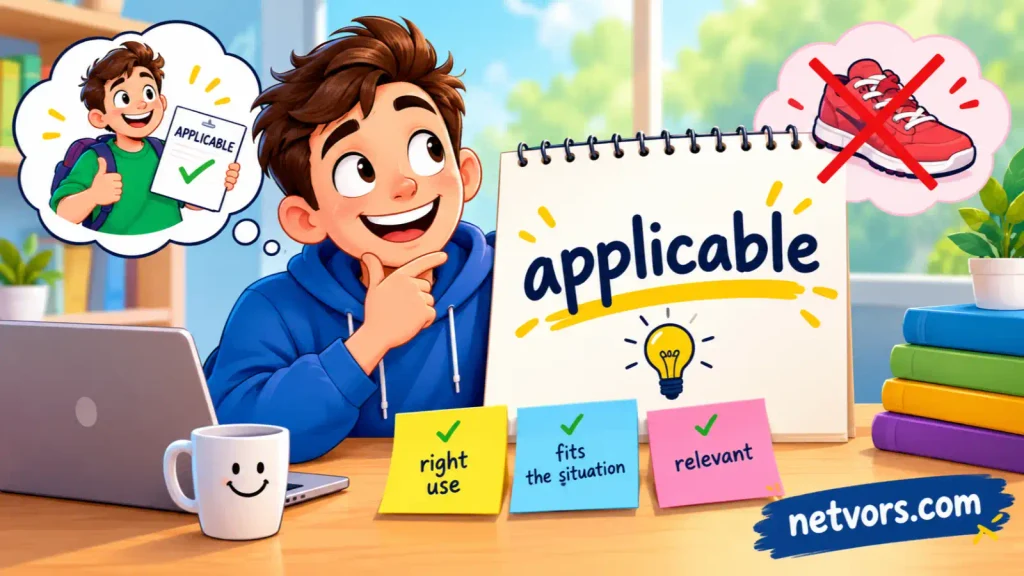
The word applicable means relevant, suitable, or capable of being applied to a particular situation, person, rule, or topic.
If something is applicable, it has a direct connection to the matter being discussed.
Quick Answer: Applicable means “relevant” or “able to be used” in a specific situation. If a rule, requirement, idea, or condition applies to you, it is applicable.
Origin of the Word
The term comes from the Latin word applicare, meaning “to attach” or “to bring into contact with.” Over time, English adopted the word to describe something that can be appropriately applied to a situation.
Unlike internet slang, “applicable” has been part of formal English for centuries and remains widely used today.
Pronunciation
Applicable is pronounced:
ap-li-kuh-buhl
Phonetic spelling:
/ˈæp.lɪ.kə.bəl/
How the Meaning Has Evolved
Historically, the word appeared mostly in legal and academic writing. Today, it’s common in:
- Online forms
- Workplace communication
- Government documents
- Educational materials
- Customer service instructions
- Software interfaces
You’ll often see phrases like:
- “Where applicable”
- “If applicable”
- “Applicable laws”
- “Applicable fees”
- “Applicable requirements”
How to Use “Applicable” Correctly in Texts & Chat

Although applicable is a formal English word, people still use it in everyday communication.
Correct Contexts
Use “applicable” when discussing:
- Rules
- Policies
- Conditions
- Instructions
- Requirements
- Recommendations
- Laws
- Procedures
Examples:
- “The discount is applicable to students only.”
- “These guidelines are applicable to all employees.”
- “The advice is applicable to beginners.”
Platform-Specific Usage
SMS & Text Messages
Usually shortened for simplicity.
Example:
“That tip isn’t really applicable here.”
Common in work groups and educational discussions.
Example:
“Please submit the documents, if applicable.”
Instagram DMs
Less common but still used when discussing specific situations.
Example:
“Use the promo code where applicable.”
X (Twitter)
Often used in professional, financial, and legal conversations.
Example:
“Taxes are applicable depending on your region.”
Discord
Common in gaming rules and community guidelines.
Example:
“Applicable server rules must be followed.”
Frequently appears in advice-based discussions.
Example:
“That solution is only applicable to Windows users.”
When NOT to Use It
Avoid using “applicable” when a simpler word works better.
Instead of:
“The joke is applicable.”
Consider:
“The joke is relevant.”
Formatting Tips
There are no special capitalization rules.
Correct:
- applicable
- Applicable
- if applicable
Common pairings:
- ✔️ If applicable
- ✔️ Where applicable
- ✔️ When applicable
Real Conversation Examples Using “Applicable”
Between Friends
Alex: Can I use this coupon at every store?
Jamie: No, it’s only applicable at participating locations.
Meaning: The coupon applies only to certain stores.
In a Workplace Chat
Manager: Does this training apply to remote workers?
HR: Yes, it’s applicable to all employees.
Meaning: Every employee must complete the training.
Family Conversation
Parent: Do these rules apply during holidays?
Teen: I think they’re still applicable.
Meaning: The rules remain relevant.
College Discussion
Student: Is this chapter included in the exam?
Professor: Yes, all applicable material from Units 1–5 will be tested.
Meaning: Relevant content from those units is included.
Gaming Community
Player: Does the update affect console users?
Moderator: The changes are only applicable to PC players.
Meaning: The update applies exclusively to PC users.
Common Mistakes & Misunderstandings
1. Confusing Applicable with Available
Incorrect:
“The discount is applicable in stock.”
Correct:
“The discount is available.”
Applicable refers to relevance, not availability.
2. Using It for Every Situation
Some people overuse the word because it sounds professional.
Instead of:
“That movie is applicable.”
Say:
“That movie is relevant.”
3. Misunderstanding “If Applicable”
Many people assume it means mandatory.
Actually, it means:
“Only if it applies to your situation.”
Example:
A form asks for a spouse’s information “if applicable.”
If you’re unmarried, you can skip it.
Generational Differences
Older generations often encounter the term in legal or administrative documents.
Younger users typically see it on:
- Online applications
- Software forms
- School portals
- Digital subscriptions
How to Clarify
If someone doesn’t understand the word, explain it as:
“Relevant to this situation.”
That’s usually the simplest interpretation.
“Applicable” Across Different Platforms & Demographics
Gen Z
Gen Z doesn’t use “applicable” as slang. Instead, they encounter it through:
- School systems
- Scholarship forms
- Online registrations
- Digital services
Millennials
Millennials commonly use it in:
- Workplace communication
- Project management
- Email correspondence
Older Generations
Frequently used in:
- Contracts
- Government paperwork
- Legal documents
- Tax-related communication
Social Media Usage
TikTok
Rarely used in casual content but appears in educational and career-focused videos.
Mostly seen in promotional terms and conditions.
Discord
Common in moderation guidelines and server rules.
Frequently used in technical and advice-oriented discussions.
Is It Formal or Informal?
Applicable is generally considered:
| Context | Appropriate? |
|---|---|
| Academic Writing | Yes |
| Business Emails | Yes |
| Legal Documents | Yes |
| Government Forms | Yes |
| Casual Chat | Sometimes |
| Internet Slang | No |
Safe for Work?
Yes.
The term is completely professional and safe for educational, workplace, and public use.
Related Slang, Abbreviations & Alternatives
While “applicable” isn’t slang, several related words carry similar meanings.
| Term | Meaning |
|---|---|
| Relevant | Directly connected to the topic |
| Appropriate | Suitable for the situation |
| Pertinent | Closely related to the matter |
| Suitable | Proper or fitting |
| Related | Connected in some way |
| Valid | Acceptable or officially recognized |
| Useful | Helpful in practice |
| Practical | Effective in real situations |
| Inapplicable | Not relevant or suitable |
| Irrelevant | Unrelated to the discussion |
Synonyms
- Relevant
- Appropriate
- Suitable
- Pertinent
- Related
- Valid
Antonyms
- Inapplicable
- Irrelevant
- Unrelated
- Unsuitable
FAQs:
What does applicable mean in simple words?
Applicable means something is relevant or can be used in a particular situation. If a rule, condition, or requirement affects you, it is applicable to you.
What does “if applicable” mean?
“If applicable” means you should provide information or follow instructions only if they relate to your circumstances. If they don’t apply, you can ignore them.
Is applicable a formal word?
Yes. It is most common in professional, legal, academic, and administrative communication. However, people also use it in everyday conversations.
What is an example of applicable?
A sentence example would be:
“Student discounts are applicable on weekdays.”
This means the discount applies during weekdays.
What is the opposite of applicable?
The opposite is inapplicable, which means something does not apply or is not relevant to a specific situation.
Conclusion:
The applicable meaning is simple once you break it down: it refers to something that is relevant, suitable, or able to be applied to a particular situation.
You’ll most often encounter the word in forms, workplace communication, educational materials, policies, and legal documents. Understanding it helps you interpret instructions accurately and communicate more effectively.
The next time you see “if applicable” or “where applicable,” you’ll know exactly what it means and whether it applies to you. Explore more language guides and modern word meanings to keep expanding your vocabulary.
What’s a word or phrase you’ve recently looked up? Drop it in the comments and keep the conversation going!

Hi, I’m John Cate, the voice behind Netvors.com, where I turn confusing words into clear meaning.
I’ve always been fascinated by how language evolves. One day a word means one thing, the next day it means something completely different, especially online. That shift is exactly what inspired me to build Netvors: a space where meanings are simple, accurate, and actually useful.