
Have you ever wondered why some people seem happy despite earning an average income, while others achieve wealth but still feel unfulfilled? That’s where understanding the American Dream meaning becomes important.
For decades, the American Dream has represented hope, opportunity, success, and the belief that anyone can build a better life through hard work and determination. But in today’s fast-changing world, its meaning has evolved. For some, it means owning a home and raising a family. For others, it’s about financial freedom, personal happiness, remote work, or simply having the freedom to choose their own path.
In this guide, you’ll discover what the American Dream really means, where the idea originated, the hidden signs that show you’re already living it, and why many people misunderstand its true purpose. Whether you’re a student, professional, immigrant, or simply curious, this updated guide explains everything in plain English with practical examples.
What Does “American Dream” ?

The American Dream is the belief that every person has the opportunity to achieve success, financial stability, and a better quality of life through hard work, determination, and equal opportunity—regardless of where they were born or their background.
At its core, the American Dream isn’t just about becoming rich. Instead, it’s about having the freedom to pursue your goals and create a life that feels meaningful to you.
For some people, this means:
- Owning a home
- Starting a successful business
- Building a loving family
- Getting a quality education
- Achieving financial independence
- Having the freedom to make life choices
Today’s interpretation is much broader than it was decades ago. Many people now define success based on personal happiness rather than wealth alone.
Pronunciation
American Dream
uh-MAIR-ih-kuhn dreem
Origin and History of the American Dream
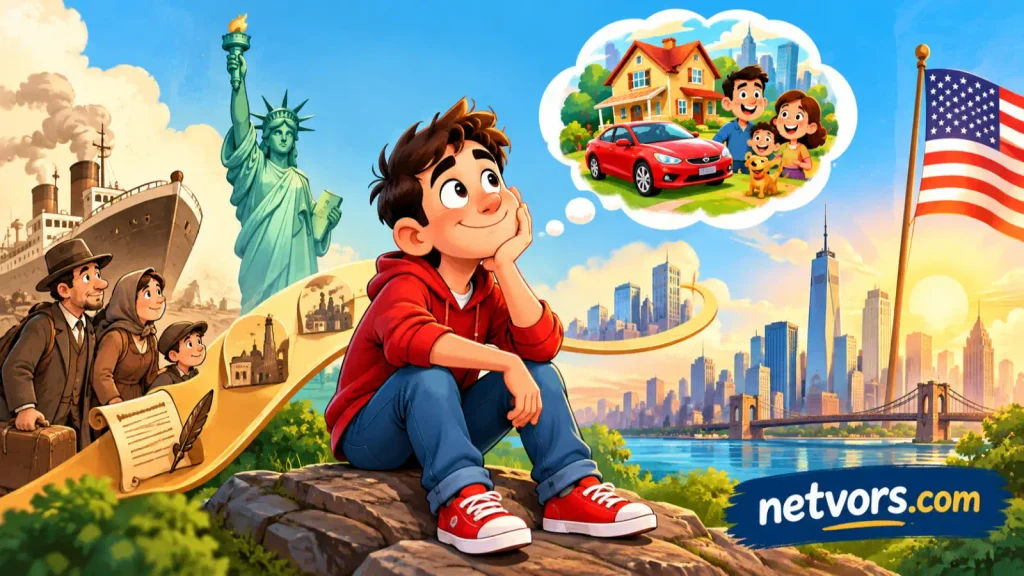
The phrase “American Dream” became widely known after historian James Truslow Adams introduced it in his 1931 book The Epic of America.
Interestingly, Adams wasn’t talking only about money.
He described the American Dream as a society where every individual could reach their full potential regardless of their social class or birthplace.
During the 1930s, America was facing the Great Depression. Millions struggled financially, yet the idea of hope and opportunity became even more meaningful.
Over time, the concept evolved through different decades.
1940s–1950s
Following World War II, the American Dream often meant:
- Buying a suburban home
- Owning a car
- Stable employment
- Supporting a family on one income
This era shaped the traditional image many people still associate with the American Dream.
1960s–1980s
As society changed, education and career advancement became larger parts of the dream.
Civil rights movements also emphasized equal opportunities for everyone, expanding the definition beyond economic success.
1990s–2010s
Technology transformed career opportunities.
Entrepreneurship, higher education, and digital innovation allowed many people to pursue success in entirely new ways.
Owning a business became just as desirable as working for a large company.
2020s and Beyond
Today, younger generations often define the American Dream differently.
Instead of focusing only on possessions, many value:
- Work-life balance
- Mental health
- Remote work
- Flexible careers
- Travel opportunities
- Passive income
- Personal fulfillment
The dream has become more personal than universal.
How the Meaning Has Changed Over Time
Although the core belief remains the same—opportunity through effort—the definition has expanded significantly.
| Traditional American Dream | Modern American Dream |
|---|---|
| Own a house | Financial freedom |
| Lifetime career | Flexible career |
| Large family | Personal choice |
| Material success | Happiness and purpose |
| Job security | Lifestyle freedom |
| Retirement after decades | Early financial independence |
This shift reflects changing economic conditions, technological advancements, and evolving social values.
Today, many people believe success isn’t measured solely by salary but by overall quality of life.
Hidden Signs You Shouldn’t Ignore
Many people assume they haven’t achieved the American Dream because they don’t own a mansion or earn millions.
In reality, you may already be living aspects of it without realizing it.
Here are several hidden signs.
1. You Have the Freedom to Make Your Own Choices
One of the greatest privileges is being able to choose your career, education, or lifestyle.
Freedom itself is a powerful form of success.
2. You’re Improving Your Life Every Year
Progress matters more than perfection.
Whether you’re learning new skills, paying off debt, or building healthier habits, you’re moving closer to your own version of the American Dream.
3. You Feel Safe Expressing Your Ideas
Being able to speak openly, pursue your beliefs, and participate in society represents freedoms that millions around the world still seek.
4. You Have Access to Education
Education has always been one of the strongest foundations of opportunity.
Even free online courses and digital learning platforms make it possible to improve your future.
Knowledge creates opportunities.
5. You Can Change Careers
Years ago, many people worked one job their entire lives.
Today, changing careers is increasingly common.
The ability to reinvent yourself is a modern version of the American Dream.
6. You’re Building Financial Stability
You don’t need to be wealthy.
Saving money consistently, investing wisely, or reducing debt are all meaningful indicators of financial progress.
7. You Have Time for Family and Friends
Success isn’t only measured by income.
Strong relationships contribute significantly to life satisfaction.
Many people now consider work-life balance one of the greatest achievements.
8. You’re Pursuing Something You’re Passionate About
Whether you’re launching a small business, creating content online, freelancing, or studying a subject you love, you’re exercising the freedom to pursue your ambitions.
That reflects the spirit behind the American Dream.
Are You Already Living the American Dream?
You may already be closer than you think.
Ask yourself these questions:
- Can I make important decisions about my future?
- Am I improving my skills each year?
- Do I have opportunities to grow professionally?
- Am I working toward financial stability?
- Can I express my opinions freely?
- Do I spend meaningful time with people I care about?
- Am I building a life that matches my personal values?
If you answered “yes” to several of these questions, you’re already experiencing important parts of the American Dream—even if your journey is still unfolding.
Remember, the American Dream isn’t a final destination.
It’s an ongoing process of growth, opportunity, resilience, and creating a life that feels successful on your own terms.Real-Life Examples of the American Dream
The American Dream looks different for everyone. Here are some everyday examples that show how the idea plays out in real life.
Example 1: A First-Generation College Student
Scenario
Sarah is the first person in her family to attend college. She works a part-time job, earns scholarships, and graduates with a degree that helps her start a rewarding career.
Why it reflects the American Dream
Her story isn’t just about education. It’s about opportunity, determination, and creating a better future than previous generations.
Example 2: A Small Business Owner
Scenario
Ahmed starts a small online store from his apartment. After years of hard work, he hires employees and turns his side hustle into a full-time business.
Why it reflects the American Dream
Entrepreneurship has become one of the clearest modern examples of building success through persistence and innovation.
Example 3: Buying a First Home
Scenario
After years of saving and careful budgeting, Maria and her partner purchase their first home.
Why it reflects the American Dream
Homeownership has long symbolized stability, independence, and building wealth for future generations.
Example 4: Choosing a Better Work-Life Balance
Scenario
David leaves a stressful corporate job to work remotely as a freelance designer. Although he earns slightly less, he enjoys more time with his family.
Why it reflects the American Dream
For many people today, freedom and happiness matter just as much as a higher salary.
Example 5: Starting Over Later in Life
Scenario
At age 52, Linda returns to school, learns software development, and begins a completely new career.
Why it reflects the American Dream
The ability to reinvent yourself is one of the strongest examples of opportunity regardless of age.
Common Misunderstandings About the American Dream
Although the phrase is widely used, it’s often misunderstood. Here are the biggest myths.
Myth 1: The American Dream Means Becoming Rich
Reality
Wealth can be part of the dream, but it isn’t the whole story.
Many people measure success by happiness, personal growth, meaningful relationships, or having the freedom to choose how they live.
Myth 2: Everyone Has the Same Dream
Reality
No two people define success exactly the same way.
For one person, success might mean becoming a doctor.
For another, it could mean traveling the world, raising children, or running a small business.
The American Dream is personal.
Myth 3: Hard Work Always Guarantees Success
Reality
Hard work is important, but factors like education, economic conditions, family support, health, and opportunity also influence outcomes.
Success usually comes from a combination of effort, persistence, adaptability, and access to opportunities.
Myth 4: It’s Only Relevant in America
Reality
While the phrase originated in the United States, similar ideas exist worldwide.
Many countries encourage people to pursue education, financial stability, entrepreneurship, and a better quality of life.
The American Dream Across Different Generations
The meaning of the American Dream has shifted over time as society, technology, and economic conditions have changed.
Baby Boomers
Many Boomers grew up believing success meant:
- A stable full-time job
- Buying a house
- Raising a family
- Staying with one employer for decades
- Retiring comfortably
For this generation, security and stability were often the highest priorities.
Generation X
Gen X experienced major technological and economic changes.
Many focused on:
- Career growth
- Financial independence
- Homeownership
- Balancing work and family
They often valued both stability and personal achievement.
Millennials
Millennials entered adulthood during periods of economic uncertainty and rising living costs.
Many define the American Dream as:
- Flexible careers
- Meaningful work
- Affordable housing
- Travel opportunities
- Better work-life balance
Owning a home is still important to many, but it’s no longer the only measure of success.
Generation Z
Gen Z tends to have an even broader definition.
Common priorities include:
- Mental health
- Remote work
- Entrepreneurship
- Digital careers
- Passive income
- Personal freedom
- Authenticity
Rather than following a traditional path, many Gen Z adults prefer creating careers that align with their values.
Is the American Dream Still Possible?
This question sparks debate.
Some believe rising housing costs, student debt, inflation, and changing job markets have made the American Dream more difficult to achieve.
Others argue that today’s technology creates opportunities previous generations never had.
For example:
- Remote work allows people to live almost anywhere.
- Online businesses require relatively low startup costs.
- Freelancing creates flexible career options.
- Digital education makes learning more accessible than ever.
The path may look different, but many people still believe the American Dream is achievable through continuous learning, adaptability, and persistence.
Related Terms and Similar Concepts
Understanding these related ideas can help you better understand the American Dream.
| Term | Meaning |
|---|---|
| Opportunity | The chance to improve your life through effort and ability. |
| Financial Freedom | Having enough income or savings to live comfortably without constant financial stress. |
| Upward Mobility | Improving your social or economic position over time. |
| Entrepreneurship | Building and growing your own business. |
| Success | Achieving personal or professional goals. |
| Freedom | The ability to make choices about your own life. |
| Meritocracy | The belief that people succeed based on talent and hard work. |
| Self-Made | Achieving success largely through your own efforts. |
| Quality of Life | Overall well-being, including health, happiness, and security. |
| Economic Opportunity | Access to jobs, education, and resources that support personal growth. |
These concepts often overlap with the American Dream, but each highlights a different aspect of what success can mean.
FAQs:
What is the American Dream in simple words?
The American Dream is the belief that anyone can build a better life through hard work, determination, and access to opportunities, regardless of their background.
Who created the term “American Dream”?
Historian James Truslow Adams popularized the phrase in his 1931 book The Epic of America. He used it to describe equal opportunity and the chance for every person to achieve a fulfilling life.
Does the American Dream only mean becoming wealthy?
No.
While financial success can be part of it, the American Dream also includes freedom, education, personal happiness, career satisfaction, family life, and achieving individual goals.
Why is the American Dream important?
It represents hope and possibility.
The idea encourages people to pursue education, work hard, overcome obstacles, and build a future that reflects their personal definition of success.
Is the American Dream still relevant in 2026?
Yes, although its meaning has evolved.
Today, many people associate it with flexibility, financial independence, mental well-being, meaningful work, and having the freedom to design their own lives instead of following a single traditional path.
Conclusion:
The American Dream meaning has never been limited to money or material possessions. At its heart, it represents the opportunity to build a better life through determination, personal growth, and the freedom to pursue your goals.
For some people, that dream is owning a home. For others, it’s starting a business, earning a degree, spending more time with family, or enjoying the flexibility to work on their own terms. There is no single definition that fits everyone—and that’s exactly what makes the concept so powerful.
As society continues to evolve, so does the American Dream. What matters most isn’t comparing your journey to someone else’s, but creating a life that aligns with your values, ambitions, and idea of success.
What does the American Dream mean to you? Share your thoughts in the comments below, and explore our other guides to discover more fascinating meanings, cultural concepts, and everyday expressions.

Hi, I’m John Cate, the voice behind Netvors.com, where I turn confusing words into clear meaning.
I’ve always been fascinated by how language evolves. One day a word means one thing, the next day it means something completely different, especially online. That shift is exactly what inspired me to build Netvors: a space where meanings are simple, accurate, and actually useful.