
Have you ever seen someone use the word leaf in a conversation and wondered whether they were talking about a tree, a book page, or using it in a completely different way? English is full of words with multiple meanings, and leaf meaning is one of the best examples.
Depending on the situation, “leaf” can refer to part of a plant, a single sheet of paper in a book, or even appear in idioms and everyday expressions.
Understanding the meaning of leaf is useful for students, English learners, writers, and anyone who wants to communicate more naturally.
While its primary definition is simple, its extended meanings and expressions often confuse non-native speakers.
Updated for 2026, this guide explains the definition, origin, pronunciation, common uses, examples, and related words in clear, simple English.
By the end, you’ll know exactly how and when to use “leaf” correctly in everyday conversations and writing.
What Does Leaf ?
Quick Answer: A leaf is the flat, usually green part of a plant that grows from a stem or branch and helps the plant make food through photosynthesis. The word can also mean a single sheet of paper in a book or be used in several common English expressions.
The most common leaf meaning is the green structure found on trees, flowers, and other plants. Leaves capture sunlight, absorb carbon dioxide, and help plants produce energy.
However, English gives the word several additional meanings.
A leaf may also refer to:
- A single page in a book or notebook.
- A movable section of a folding table.
- A hinged part of a door or gate.
- A thin decorative layer of metal, such as gold leaf.
Because of these different meanings, context is essential when interpreting the word.
Pronunciation
Leaf is pronounced:
/liːf/
It rhymes with:
- Beef
- Chief
- Brief
Plural Form
One small detail often confuses English learners.
- Singular: Leaf
- Plural: Leaves
Examples:
✅ One leaf fell from the tree.
✅ The autumn leaves covered the road.
The Origin of the Word “Leaf”
The word leaf has a long history that dates back to Old English. It comes from the Old English word lēaf, which referred to the foliage of plants and trees.
Linguists believe it shares roots with similar Germanic words found in:
- Old High German
- Dutch
- German
- Old Norse
For hundreds of years, the primary meaning remained the same—the flat green part of a plant. As books became more common, English speakers started using the word leaf to describe a single sheet of paper because its thin, flat shape resembled a plant leaf.
Later, architects, furniture makers, and engineers adopted the term for movable flat parts of doors, tables, and gates.
Today, the word continues to be one of the most versatile nouns in the English language.
How to Use “Leaf” Correctly in Texts & Everyday English
Although leaf isn’t internet slang or a chat abbreviation, it’s an extremely common everyday English word. Knowing the correct context helps avoid confusion.
1. Talking About Plants
This is the most common usage.
Examples:
- The leaf turned yellow during autumn.
- That plant has large green leaves.
- Every leaf on the tree looked healthy.
This meaning is appropriate in both casual and formal communication.
2. Referring to Book Pages
Publishers, librarians, and historians often use leaf instead of “page.”
Example:
- The ancient manuscript contains over 300 leaves.
A leaf has two sides:
- Front (recto)
- Back (verso)
This meaning is mostly used in publishing and academic settings.
3. Furniture
Some tables have an extra folding section called a leaf.
Example:
- We added the table leaf before dinner.
This extension makes the table larger when needed.
4. Doors and Gates
Large doors often consist of two separate parts called door leaves.
Example:
- Open both leaves of the gate.
Architects and builders commonly use this terminology.
5. Decorative Materials
Gold leaf and silver leaf are extremely thin sheets of precious metal.
Examples:
- The picture frame was covered in gold leaf.
- Artists often use silver leaf in decorative designs.
When Should You Use “Leaf”?

Use the word naturally when discussing:
- Nature
- Gardening
- Trees
- Flowers
- Books
- Publishing
- Furniture
- Architecture
- Home improvement
- Art
When Should You NOT Use Leaf
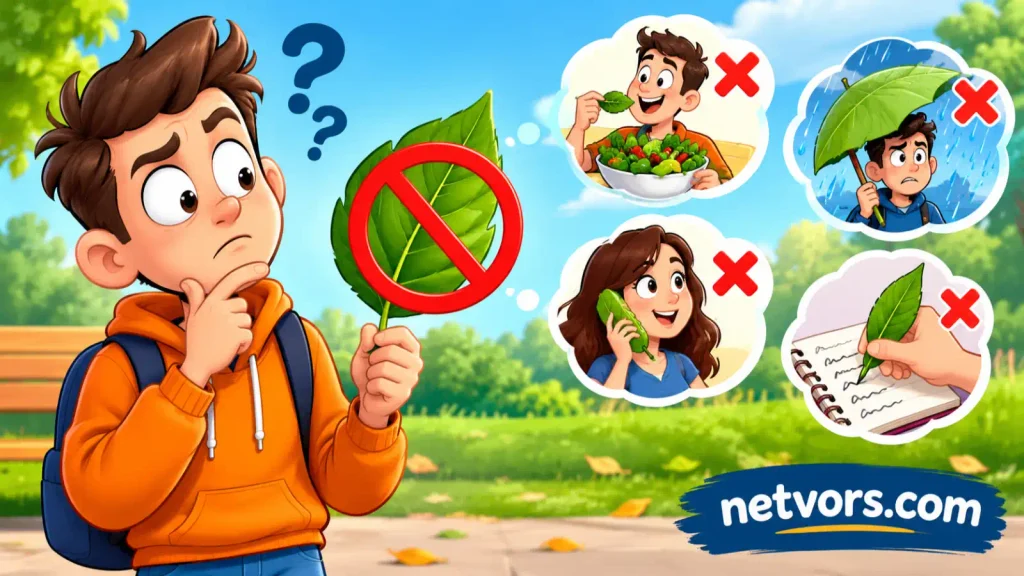
Some English learners confuse leaf with similar-sounding or related words.
Avoid using leaf when you actually mean:
- Page (general conversation)
- Branch
- Stem
- Flower
- Plant
- Tree
For example:
❌ The tree has many branches called leaves.
✅ The tree has many leaves growing on its branches.
Writing & Formatting Tips
The word is usually written in lowercase unless it begins a sentence.
Examples:
- leaf
- Leaf
- leaves
It does not require special capitalization in text messages, emails, or social media.
Real Conversation Examples Using “Leaf”
Below are several natural conversations showing different meanings of leaf.
Example 1 – Between Friends
Emma: Look at this leaf.
Ryan: Wow, the colors are beautiful.
Emma: Autumn is finally here.
Meaning
Here, leaf refers to a colorful tree leaf during the fall season.
Example 2 – In School
Teacher: Turn to the next leaf in the manuscript.
Student: Do you mean the next page?
Teacher: Yes, historians usually call it a leaf.
Meaning
The teacher uses the publishing definition of leaf.
Example 3 – Family Dinner
Dad: Can someone add the table leaf?
Daughter: Sure, so everyone has enough room.
Meaning
The word describes the removable section of a dining table.
Example 4 – Home Renovation
Builder: We’ll replace the damaged door leaf tomorrow.
Owner: Sounds good.
Meaning
The conversation refers to one movable section of the door.
Example 5 – Art Studio
Artist: I’m finishing this frame with gold leaf.
Visitor: It gives it such an elegant look.
Meaning
Gold leaf refers to an extremely thin decorative sheet of gold.
Common Mistakes & Misunderstandings
Even native speakers occasionally misuse leaf in certain contexts.
1. Confusing “Leaf” With “Leave”
These words sound similar but have different meanings.
Leaf
- A part of a plant.
Leave
- To go away.
- Permission to be absent.
- The plural of “leaf” is leaves, which makes this even more confusing for learners.
Example:
❌ I picked three leave.
✅ I picked three leaves.
2. Forgetting the Irregular Plural
Many beginners incorrectly write:
❌ Leafs
The correct plural is:
✅ Leaves
Only a few special names (such as sports teams or product names) intentionally use “Leafs.”
3. Assuming Every “Page” Is Called a Leaf
In everyday conversation, most people simply say:
- Page
Instead of:
- Leaf
The publishing meaning is correct but less common outside academic or printing contexts.
Cultural & Regional Differences
Across English-speaking countries—including the United States, the United Kingdom, Canada, and Australia—the primary meaning of leaf remains the same.
However, some specialized meanings are more common in certain professions:
- Librarians frequently use “leaf” for book pages.
- Furniture retailers often mention table leaves.
- Architects use the term for doors and gates.
- Artists commonly refer to gold leaf and silver leaf.
Because of these differences, context usually makes the intended meaning clear.
“Leaf” Across Different Contexts & Generations
Unlike internet slang that changes quickly, leaf has remained remarkably stable for centuries. Still, different groups are more familiar with certain meanings.
Children
Children usually learn leaf as the green part of a plant during their earliest science lessons.
Students
As they progress through school, students may encounter the publishing meaning when studying history, literature, or ancient manuscripts.
Adults
Most adults use leaf naturally when discussing gardening, landscaping, books, or home furniture.
Professionals
Specialized industries use the word differently.
Examples include:
- Botanists studying plant leaves.
- Librarians cataloging historical books.
- Interior designers discussing table leaves.
- Architects referring to door leaves.
- Artists applying gold leaf to decorative projects.
Understanding these professional meanings makes the word even more useful.
Related Words, Synonyms & Alternatives
The exact synonym depends on the context because leaf has several meanings.
| Word | Meaning | Best Used When |
|---|---|---|
| Foliage | Plant leaves collectively | Nature writing |
| Blade | A blade of grass | Gardening |
| Frond | Large fern or palm leaf | Botany |
| Page | Sheet in a book | Everyday English |
| Sheet | Single piece of paper | General writing |
| Petal | Part of a flower | Flowers (not leaves) |
| Branch | Limb of a tree | Trees |
| Stem | Supports leaves and flowers | Plants |
| Gold Leaf | Thin sheet of gold | Art and decoration |
| Silver Leaf | Thin decorative silver | Crafts and artwork |
You may also encounter related expressions such as:
- Turn over a new leaf
- Leaf through a magazine
- Shake like a leaf
- Every leaf tells a story (poetic usage)
FAQs:
Is a leaf only part of a plant?
No. While the most common leaf meaning is the green part of a plant, the word has several other meanings in English. It can refer to a single sheet of paper in a book, a folding section of a table, one side of a door or gate, or an ultra-thin sheet of metal such as gold leaf. The correct meaning always depends on the context.
What is the difference between “leaf” and “leave”?
Although they sound similar, they have different meanings.
- Leaf is a noun that usually refers to the green part of a plant.
- Leave is commonly used as a verb meaning “to go away” or as a noun referring to permission to be absent from work or school.
One common mistake is writing leafs instead of the correct plural, leaves.
What is the plural of leaf?
The plural of leaf is leaves, not leafs.
Examples:
- The tree has beautiful leaves.
- Autumn leaves covered the garden.
English has many irregular plurals, and “leaf” is one of them. Remembering this rule will help your writing sound more natural.
Why is a book page called a leaf?
In publishing, printing, and bookbinding, a leaf is one physical sheet of paper. Since each sheet has two sides, one leaf contains two pages—one on the front and one on the back.
This usage has existed for centuries and is still common in libraries, archives, and historical studies.
What does “turn over a new leaf” mean?
The idiom turn over a new leaf means to make a fresh start by changing your behavior or improving your habits.
Examples:
- After New Year’s Day, he decided to turn over a new leaf and exercise regularly.
- She turned over a new leaf by spending less time on social media.
The phrase has nothing to do with actual plant leaves. Instead, it symbolizes starting a new chapter in life.
What does “leaf through” mean?
Leaf through means to flip quickly through the pages of a book, magazine, or notebook without reading every word.
Example:
- I leafed through the magazine while waiting for my appointment.
It suggests browsing rather than reading carefully.
Is “leaf” formal or informal?
The word leaf itself is neither formal nor informal. It is a standard English word used in everyday conversations, schools, books, scientific writing, and professional settings.
Some meanings are more common in specialized fields, such as publishing or architecture, but the word is appropriate in both casual and formal communication.
Can “leaf” be used as a verb?
Yes. Although it’s less common than the noun, leaf can also be used as a verb.
Examples:
- She leafed through the notebook before the meeting.
- He spent an hour leafing through old family albums.
As a verb, it means to turn pages quickly rather than read them carefully.
Conclusion:
The leaf meaning is much broader than many people realize. Most commonly, it refers to the green part of a plant, but it can also describe a page in a book, a folding section of a table, part of a door, or even a delicate sheet of decorative metal. Learning these different meanings makes it easier to understand English in everyday life, literature, and professional settings.
If you’re learning English, paying attention to context is the easiest way to understand which meaning of leaf is being used. The same word can represent nature, books, furniture, architecture, or art, and native speakers rely on surrounding words to make the meaning clear.
Now that you understand leaf meaning, pronunciation, origin, examples, and common expressions, you’ll be able to use the word with confidence in both speaking and writing.
What’s your favorite English word with multiple meanings? Share it in the comments below, and explore more vocabulary guides to keep expanding your English skills!

Hi, I’m John Cate, the voice behind Netvors.com, where I turn confusing words into clear meaning.
I’ve always been fascinated by how language evolves. One day a word means one thing, the next day it means something completely different, especially online. That shift is exactly what inspired me to build Netvors: a space where meanings are simple, accurate, and actually useful.